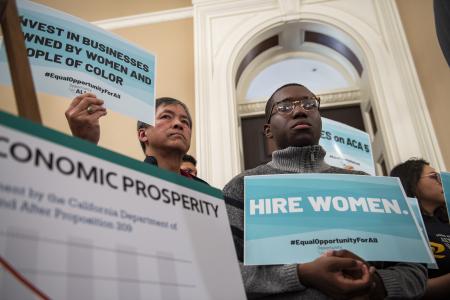

In 1996, California amended the state’s constitution to allow Proposition 209 to disperse affirmative action within California and try to create equality in which prohibits state governmental institutions from considering race, sex, or ethnicity in areas of public employment, public contracting, and public education. However many Californians believed that the Proposition, in all actuality, did more harm than good for minorities and women. Especially when it came to admissions for universities and opportunities for businesses run by minorities and women. A new bill of legislature called ACA 5 which if passed all votes will be repealing Section 31 of Article I at the November elections. Assembly-member Shirley Weber who has been the front-runner for ACA 05, believes this renewal energy to stop systematic racism could get the necessary push to vote for repealing of article 3 and that this generation of Californians have the opportunity to decide their fate on this matter.
Support of ACA 5: re-enact affirmative action
Universities are obliged to give equal opportunity to all students no matter race, gender, and creed however many believe because of Proposition 209 the system has failed minorities by not making sure there is equal representation for minorities in California’s universities system. According to information provided by The Education Trust-West and SacBee news agency recently the graduating high school class of 2019 had 53 percent of Latinx students, and 6 percent were Black, However, in the same year only 25 percent of the UC freshman class of the same year were Latinx, and 4 percent were Black, thus the data represented for supporters that there is a great disparity between minority students and white students counterparts acceptance rates. One supporter by the name of Varsha Sarveshwar, who is the president of the University of California Student Association best sums it up that If a university can judge every aspect of the student experience in life then it needs to be consciousness about race which is part of that student’s lived experience.
As well as Prop 209 has not just affect college admissions procedures but as well as employment and minority businesses. The Equal Justice Society claim Proposition 209 not only ended race-conscious programs in California but as well ended the collection of procurement data which gives a person the data needed to purchase from vendors in a preferred group even if they are not the cheapest option. As well as limiting opportunities to minorities and women-owned businesses to receive public contracts. The costly effect it has on women and minority-owned businesses billions of dollars in state contracting opportunities which ranged from $1 to $1.1 billion dollars annually. The color-blind system of Prop 209 has done the opposite of what it was made to do and the belief by supporters is that California needs a race-conscious system to help fix the racial disparities
Opponents of ACA 5
Voices heard for the opposition of ACA 5 including the Chinese American Californians believe affirmative action is its own reverse discrimination that will affect many of their own children from going to high-quality schools like Standford and such. Assemblyman Steven Choi has been a strong opponent and stated from the San Francisco Chronicles that “The act of giving special or preferential treatment to someone based on their race is racism itself, or on sex is sexism”. As well many Asian Americans like Assemblyman Choi have said that they believe in the American dream that they were told (many Asian Americans are immigrants) that based on your hard work not on your skin color that people can obtain the goals. The Asian community was one of the reasons there was strong opposition towards pass bills that would repeal Prop 209 like SCA 5 in 2014.
Another argument made by opponents is that Prop 209 is not “origin of this evil” but in all actuality points towards California’s public education system. Op-Ed claims that the UC Academic Senate task force found that there was a 22-percentage point gap between the share of the underrepresented minorities in the grade 12 class and the pool of California resident students admitted by UC. The thought is that this gap can be explained by factors that precede admissions and in context it is not the impact of Prop 209 or the admissions process, but rather the practices and performance of the K-12 school system before students even got to the admissions process. As well California has not done enough to help undeserved schools and disadvantaged students, especially for academic outcomes for high-needs students in these undeserved schools. Therefore rather than to blame Prop. 209, their wider socio-economic problem such as inefficient spending, unequal access, community segregation, and a shortage of qualified teachers, that are at play in this disparity we see today.
Reviewing both sides there is no right or wrong argument, each side desires to do what is best for the citizens of California. If the vote goes through June 25 we will see what this generation of Californians desires for their future.
 CIMA Law Group Blog