Trigger Warning: This article contains a story involving police brutality
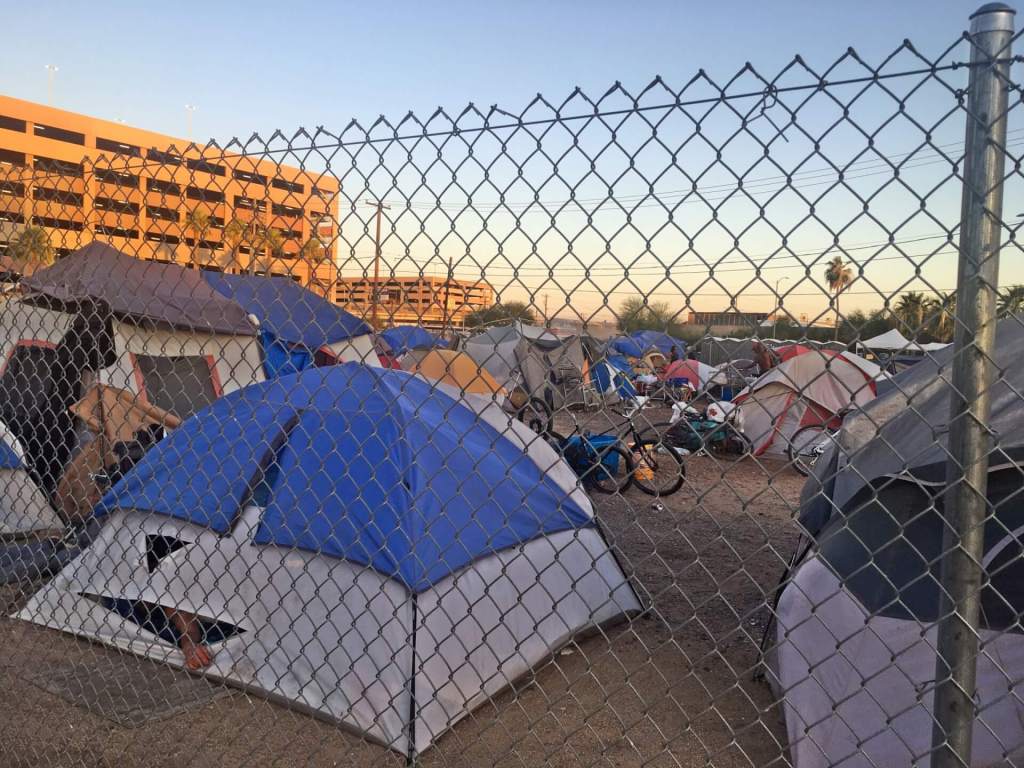
Of the 7,419 people experiencing homelessness in Maricopa County, more than half of them are unsheltered and sleeping on the street – enduring both extreme heat and increased exposure to coronavirus. Experts expect that number to rise significantly with the current economic downturn.
Meanwhile, the major shelter in Phoenix, the Human Services Campus (HSC), reports that it’s currently only able to house 390 adults with COVID-19 precautions in place. In an attempt to create more designated sleeping spaces, Maricopa County and the HSC have resorted to crowding unsheltered people into asphalt parking lots. City spokeswoman Tamra Ingersoll says that the lots technically count as shelter spaces since people living on the lots “are connected to case management and with provided services of water and bathrooms [port-a-potties] and designated space.” However, the lots themselves lack shade and are plastered with signage that read “temporary outdoor space.” The chain-link fences and armed security guards don’t help make the spaces any more inviting.
Those who refuse to live in the parking lots may be subject to arrest. In 2018, the 9th Circuit Court of Appeals banned police from ticketing or arresting people for sleeping in public when there are no alternatives to shelter, citing it as cruel and unusual. However, Phoenix city police have been using the lots’ existence as a loophole to continue to arrest and ticket people by claiming that there is available shelter. Nadeen Bender, for instance, was recently ticketed for “camping on city property” as she lay under a bush trying to recover from heat exhaustion caused by the 110-degree Fahrenheit day. She told the Phoenix New Times that it already takes around ten hours a day just to get around, get food, and get everything else she needs to survive while keeping her things safe. The ticket has been distressing for her because she doesn’t know how she will find the time or transportation to get to court.
The Human Services Campus has submitted a special permit re-zoning request to add additional beds and expand their campus boundaries, and since then, the City of Phoenix has drafted a new homelessness plan. While there are aspects of the plan that are universally agreed on as helpful – such as increasing the number of beds in shelters and increasing funding for mental health services – advocates for homeless people say the plan criminalizes people who don’t have access to shelter.
Crackdowns listed in the plan include: replacing bus benches with chairs, implementing more gates and fences around the Human Services Campus, shutting down the unlicensed distribution of food to homeless people, working with federal authorities to remove people along the Grand Canal, and establishing a universal code of conduct that facilitates banning homeless people from city property like community centers and libraries.
Advocates are worried most about how the plan centers police as the primary responders to calls for service, homeless outreach, and public property cleanups. Phoenix only requires a total of 720 hours of training to become a certified police officer and that training centers on firearms, physical conditioning, and law enforcement instruction. Meanwhile, Arizona requires a bachelor’s degree, a master’s degree, and a minimum of 3200 hours of supervised field experience to become a licensed social worker. In short, Phoenix police are being asked to perform the same duties as a social worker and mental health professional with only a fraction of the training.
This decision has proven to be deadly. Phoenix has grappled with accusations of police brutality for the last several years, yet it is one of the largest police departments in the country without civilian oversight. In 2018, it led the nation in fatal officer-involved shootings, with 23 deaths.
In 2017, Phoenix had an incident nearly identical to that of George Floyd. It began when a black homeless man, Muhammad Muhaymin Jr., tried to carry his emotional support dog, a Chihuahua named Chiquita, into the restroom of a community service center. The manager physically blocked him and told him to leave the dog outside and when an argument ensued, the manager instructed an employee to call the police. When they arrived, three Phoenix police officers arrested him and wrestled him to the pavement, Chiquita ran around scared, and Muhaymin called out for his dog, saying, “That’s my child, officer.” One officer pinned his head to the pavement with a knee, while the others kneeled on his neck and shoulders as he screamed out “Please Allah” and “I can’t breathe!” until, after eight minutes, he went limp. Muhaymin died soon after – a little more than an hour after he had walked into the community center to use the public restroom.
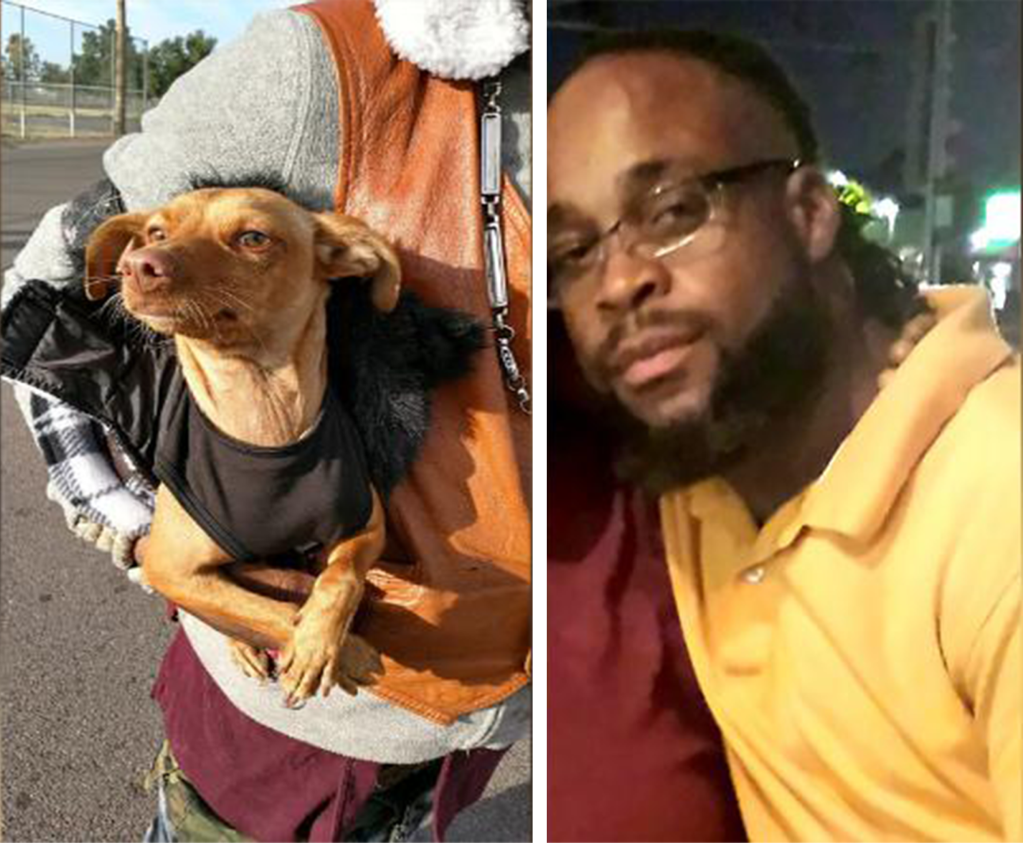
In the three years since then, none of the officers responsible for Muhaymin’s death have faced any discipline; all remain on the force and one is now a detective. Since there is no external oversight, the Phoenix Police Department conducted its own investigation into the case and said that “none of the officers’ actions on that day were found to be ‘out of policy.’”
Muhaymin’s death is one example of a larger trend. A disproportionate amount of people without shelter in Phoenix – around 30 percent – are black, in a city that is only around 7 percent black. At the same time, police use of force is among the leading causes of death for young men of color. By centering police as key implementors of its current and proposed plans on addressing homelessness, the City of Phoenix not only criminalizes homelessness but directly puts black lives at risk.
Phoenix’s proposed plan on “Strategies to Address Homelessness” is still receiving public input until August 28th before it goes into effect. To leave comments or concerns, follow this link. (Para compartir este articulo con gente hispanohablantes, oprima este enlace en Español.)
Article written by Isabela von Dehl
Sources:
Kuznia, R., Bronstein, S., & Griffin, D. (2020, July 09). Bodycam footage reveals new details about Black man’s death in custody. Retrieved August 05, 2020, from https://www.cnn.com/2020/07/09/us/phoenix-muhammad-muhaymin-invs/index.html
Baxter, E. (2020, July 16). Phoenix’s Draft Homelessness Plan Raises Hopes and Concerns. Retrieved August 05, 2020, from https://www.phoenixnewtimes.com/news/phoenix-draft-homeless-plan-hopes-portal-advocates-community-gallego-11478370
Hsieh, S. (2020, July 02). As COVID-19 Threatens Homeless, Phoenix Cops Force Them to Break Down Tents. Retrieved August 05, 2020, from https://www.phoenixnewtimes.com/news/covid-19-homeless-phoenix-tents-police-coronavirus-distancing-11464801
Edwards, F., Lee, H., & Esposito, M. (2019, August 20). Risk of being killed by police use of force in the United States by age, race–ethnicity, and sex. Retrieved August 05, 2020, from https://www.pnas.org/content/116/34/16793
Ackley, M. (2020, July 08). Is a parking lot a homeless shelter? Yes, according to City of Phoenix. Retrieved August 05, 2020, from https://www.azmirror.com/2020/07/07/is-a-parking-lot-a-homeless-shelter-yes-according-to-city-of-phoenix
 CIMA Law Group Blog