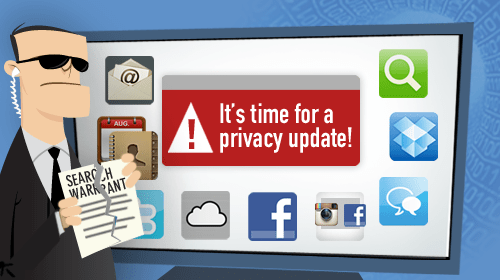
In 1986, the Electronic Communications Privacy Act (ECPA) was enacted by the United States Congress – Public Law 99-508, Statute 1848 – and is the law that “protects” the privacy of Americans’ electronic exchanges. Three years later, Tim Berners-Lee invented the World Wide Web (WWW). Notwithstanding the innovation of technology, the ECPA is primarily all that Americans have to protect their electronic privacy. This has shown to be flawed as the writers of the Electronic Communications Privacy Act could not have anticipated the privacy issues, we face in a technology heavy world.
It is for this reason that I would update the Electronic Communications Privacy Act to restore the privacy that our Founding Fathers recognized Americans were entitled to. With today’s social media networks and cheap or free cloud services, the language of the law is not sufficient in protecting the privacy of online users. The main issue with the ECPA is that the government has relatively easy access to users’ information. Currently, investigators only need a subpoena to obtain a user’s emails or other electronic messages that are stored in the cloud provided they are more than six months old. The Bill of Rights was created to provide a greater constitutional safeguard of individual liberty. Within the Bill of Rights is the Fourth Amendment which states, “The right of the people to be secure in their persons, houses, papers. And effects against unreasonable searches and seizures.” Typically, a lawfully executed warrant is needed to be able to search or seize, however, as stated before, an investigator only needs a subpoena, not a warrant approved by a judge to obtain emails or electronic messages of any user.
It is crucial for users to have the same protection under the Fourth Amendment when their “papers” and “effects” are stored electronically. The individual right to privacy as guaranteed by the Fourth Amendment should not be disregarded due to lack of foresight. As our society continues to innovate and evolve, so should the laws that protect the members of said society.
Citations
https://www.eff.org/deeplinks/2012/12/deep-dive-updating-electronic-communications-privacy-act
https://bja.ojp.gov/program/it/privacy-civil-liberties/authorities/statutes/1285
 CIMA Law Group Blog