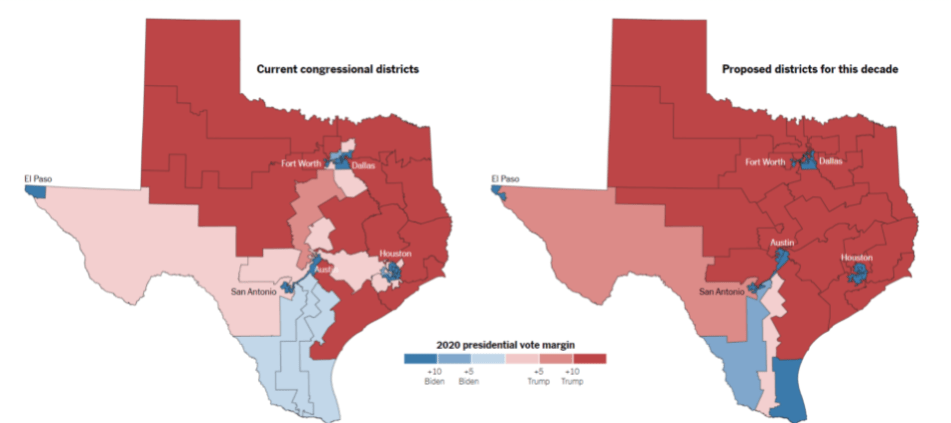
Following the 2020 census, Texas was appointed 38 congressional districts of which are drawn by the state legislature. For the first time in decades, federal law allows Texas to draw political maps without federal approval to ensure they don’t violate the rights of people of color. The new proposed congressional map of Texas for this decade aims to primarily strengthen existing Republican districts while also widening the margin in Democrat districts. According to the New York Times, under the proposed map, only one district would have fallen within a 5 percentage point margin in the 2020 election. In 2020 there were 11 districts that fell in that same 5 percentage point margin. This defensive redistricting strategy could become more prevalent in other states as well.
Four Big Changes Include:
- Adding a Republican District in Harris County- By compacting other democratic districts in Harris county, Republicans were able to draw an entirely new district where a large portion of the county’s white population lives.
- Splitting Dallas into large and rural districts- Republicans strengthened their vote margin in some Dallas districts by extending them to include large rural areas that consist of mostly republican voters
- Consolidating Democratic growth in Austin- Republicans used a strategy called “vote sink” by adding a new largely democratic district in Austin so Republicans can safely maintain their majority in the surrounding suburbs are rural areas.
- Spreading out the Latino vote- Even though Latino’s account for a large portion of Texas’ population growth, there are still no districts with a majority Latino population. This is interesting because it is unclear how Latino voters tend to vote. Trump made large strides in approval rating with Latino’s in 2020 yet most predominantly Latino areas are separated into multiple districts.
Controversy has ensued between Texas Republicans and Democrats with regards to the nature in which the congressional districts have been drawn. One example of controversy is how Sheila Jackson Lee and Al Green’s districts have been drawn together, meaning they would have to run against each other. Both members testified saying that, “It doesn’t look right for the only two persons in the state of Texas to be running against each other in a congressional district from the same party to be of African ancestry,” Even though the old map had one district with a majority black voters, the proposed new map has none. As of October 11th, 2020 the proposed district map has passed through the Texas House Committee and the Texas senate. The proposed map now moves to the Texas House before it can be signed into law by Governor Gregg Abbott. The map must be approved before the special legislative session that ends on October 19th.
This blog post is part of the CIMA Law Group Blog. If you are in need of legal help, the CIMA Law Group is a law firm in Phoenix, Arizona which possesses expertise in Immigration Law, Criminal Defense, Personal Inquiry, and Government Relations.
 CIMA Law Group Blog