
This past Monday a sleeping crew onboard the International Space Station was woken up and ordered to take shelter in their spacecraft in case the station was hit by passing debris from a Russian anti-satellite missile test. The seven people currently onboard the space station which include cosmonauts from the US, Russia, and Europe were ordered by NASA’s debris and ballistics specialists to remain in shelter from 2am to 4am. During that period the ISS executed two passes through the debris cloud as it makes a full orbit around the Earth every ninety minutes.
Impact from debris poses a significant hazard to current satellites and future space launches. Unfortunately, Russia’s recent satellite demolition only adds to a growing blanket of space junk that orbits the Earth. The Russian Ministry of Defense launched an anti-satillite missile (ASAT) Monday destroying one of its own dead satellites hurtling at least 1,700 pieces of debris at 17,000 miles per hour.
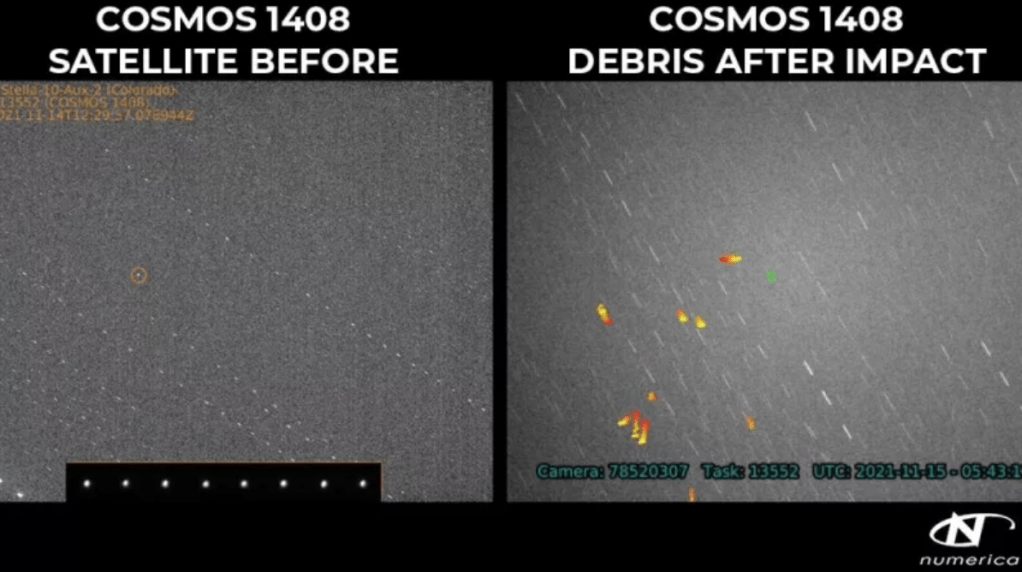
Astrophysicist and satellite tracker John McDowell of the Harvard-Smithsonian Center for Astrophysics stated the debris field created from the 3,860 pound satellite will stay in orbit for around five years. 14 years still remain for most of the debris from a 2007 Chinese ASAT test to fall back to earth, and there is still debris from Soviet tests dating back fifty years ago.
There is so much debris in space that poses a threat to the International Space Station NASA has set guidelines for debris avoidance. In order to maneuver the station from hurtling space junk the crew utilizes the station’s Russian thrusters, or they fire the propulsion systems on one of the docked spacecraft that carry people to and from Earth. Since 1999 the International Space Station has conducted twenty nine debris avoidance maneuvers, with three of those occurring just last year.
The Department of Defense currently tracks more than 27,000 pieces of orbital debris that could threaten human and robotic spaceflight, with much more being too small to detect. The debris is already impacting launch plans and has the potential to drastically decrease launch windows. This comes at a time where companies such as Space X and Boeing plan to launch as many as 65,000 satellites commercial spacecraft into orbit in the near future.
This blog post is part of the CIMA Law Group Blog. If you are in need of legal help, the CIMA Law Group is a law firm in Phoenix, Arizona which possesses expertise in Immigration Law, Criminal Defense, Personal Inquiry, and Government Relations.
 CIMA Law Group Blog