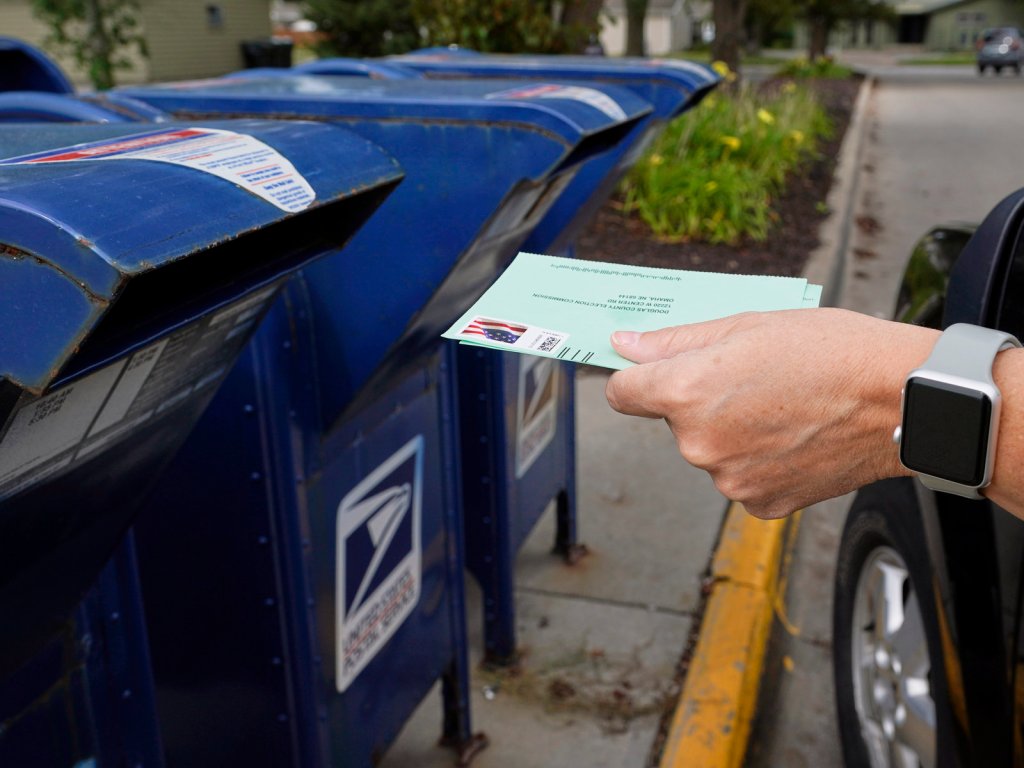
FILE – In this Tuesday, Aug. 18, 2020, file photo, a person drops applications for mail-in-ballots into a mail box in Omaha, Neb. U.S. Postal Service warnings that it can’t guarantee ballots sent by mail will arrive on time have put a spotlight on the narrow timeframes most states allow to request and return those ballots. (AP Photo/Nati Harnik, File)
The Postal Service’s operational changes have sparked scrutiny and concern regarding jeopardized mail-in voting and disenfranchised voters who wish to vote safely amid the COVID-19 pandemic. Although the Postmaster General announced the suspension of the Postal Service’s recent operational changes, he did not speak to whether those changes will be reversed (such as the removal of postal boxes and sorting machines).
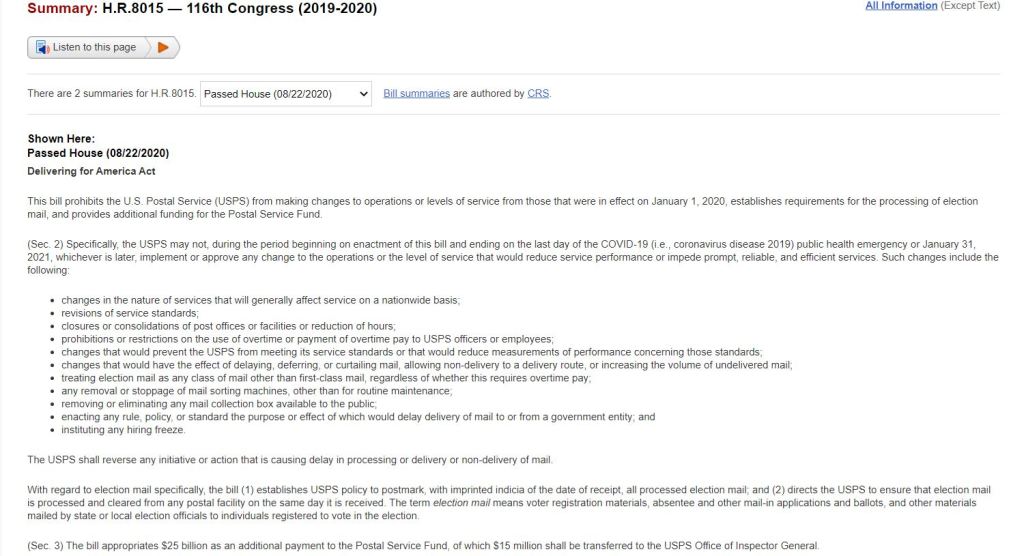
The bill, H.R.8015 – Delivering for America Act, has been met with veto threats from the White House as well as the expectation to not advance through the Republican-controlled Senate.
In recent months, it has becoming increasingly clear that the United States Postal Service is struggling to stay afloat, especially in the wake of COVID-19. The Postal Service has been hemorrhaging funds for many years now, but the reduction in income that was brought on by COVID-19 has sparked controversial action on the part of Postmaster General Louis DeJoy. DeJoy has been criticized across party lines for his initiatives to increase efficiency in the government agency, which have included closing facilities, reducing the amount of serviced mailboxes across the country, retiring well-working mail sorting machines, and disallowing overtime for mail carriers.
The Postal Service has reportedly sent letters to 46 states and Washington D.C. stating that they may not be able to get ballots for the November election to counting facilities in time to be counted. This action has sparked not only criticism, but outrage across the United States. Absentee (or “mail-in”) ballots have been a reliable method of voting for many who cannot (or do not wish to) vote at a polling center, and the idea that their votes may not be counted despite mailing them on time is incredibly concerning to many.
Many political commentators and analysts believe that this reluctance to deliver mail-in ballots on time comes, at least in part, from President Trump’s opposition to the mail-in voting system; President Trump has stated that he will oppose any emergency funding bill that Congress may approve in order to limit mail-in voting. It has been suggested that the timing of DeJoy’s (who is a long-time trump supporter) “inefficiency eliminating” measures cannot be coincidental, as they’ve begun just before one of the most critical elections in recent history.
In his testimony before a Senate committee today, DeJoy acknowledged that it is his “sacred duty” to deliver ballots in time to be counted, but provided no actual plan to make sure that this duty is fulfilled. He has confirmed that he has no plans to reopen facilities or closed mailboxes, and this has left many in Congress doubting his commitment to providing a reliable mail service pre-election.
Critics have also noted that these methods to “increase efficiency” have had adverse effects for many Americans, and especially those living in rural areas. Many in rural America rely on the Postal Service for not only their mail, but also for things like prescription medication and paychecks. Rural voters were crucial to President Trump’s election in 2016, but their support for the President is dwindling as issues with the Postal Service persist.
Essentially, this politicization of Postal Service functions has caused significant doubt in the reliability of mail-in voting for the upcoming election– so what can voting Americans do to ensure their vote is counted?
We recommend requesting your absentee ballot as soon as possible, and filling it out as soon as you get it. Mailing your ballot no later than mid-October is essential to making sure your vote is recorded, but mailing it as soon as you fill it out is optimal. If you are able, follow up with your ballot; call your election office and make sure your ballot has been received. You may also choose to forego mail-in voting altogether and vote at a polling center, if you feel comfortable doing so. Either way, it is clear that making sure that your vote is counted is more important in this election than it has been in those past.
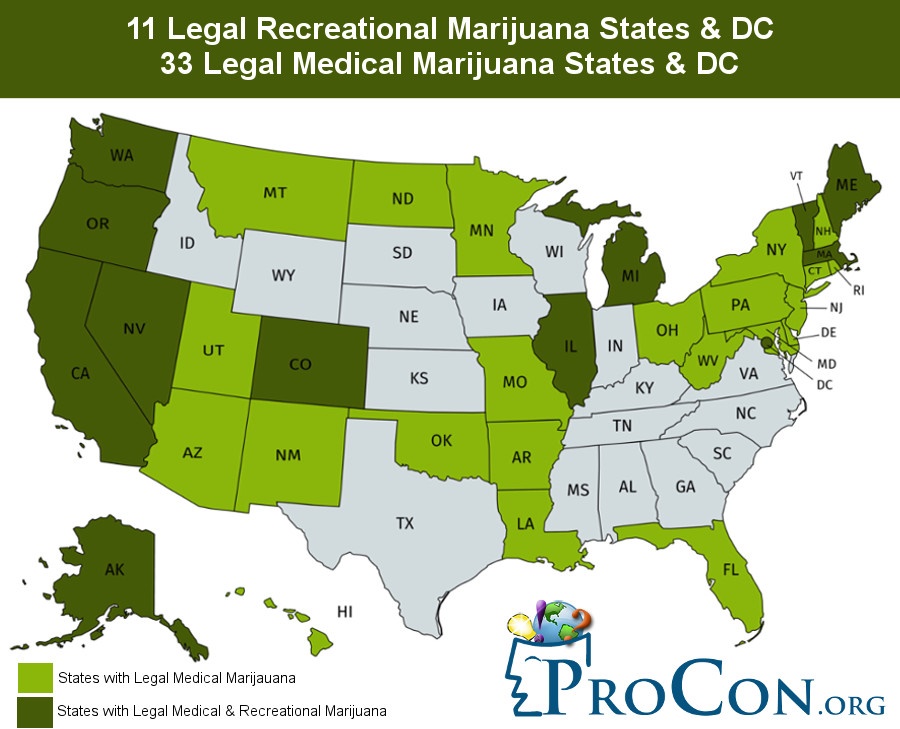
States with Legal Medical and Recreational Marijuana Use
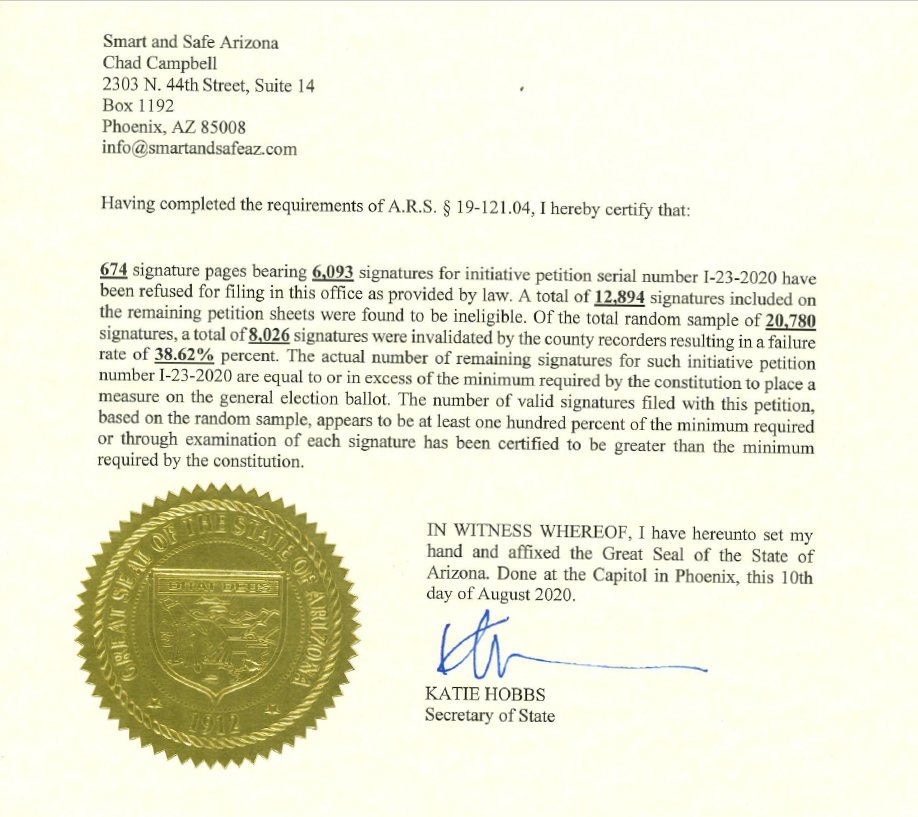
Proposition 207 (Marijuana Legalization Initiative) has been added to the ballot in Arizona for the General Election taking place on November 3, 2020. In a tweet made August 10, Secretary of State Katie Hobbs confirmed the appearance of Prop. 207 on Arizona’s General Election ballot. The decision to add Prop. 207 to the ballot is owed to the Smart and Safe Initiative, a citizens’ initiative to legalize recreational marijuana use for adults 21 years of age and over. The Smart and Safe initiative submitted 420,000 signatures, 255,080 of which were valid — surpassing the required amount of 237,645signatures.
A “Yes“ vote for Proposiiton 207 “supports this ballot initiative to legalize the possession and use of marijuana for persons who are at least 21 years old, enact a tax on marijuana sales, and require the state Department of Health and Human Services to develop rules to regulate marijuana businesses” (Ballotpedia, 2020).
A “No“ vote for Proposition 207 “opposes this ballot initiative, thus keeping the recreational possession and use of marijuana illegal under state law in Arizona” (Ballotpedia, 2020).
Allow employers and property owners to prohibit use at their workplaces and on their property, like they do currently.
Ban smoking marijuana in public places like restaurants and open spaces like sidewalks and parks.
Create thousands of good-paying jobs across Arizona.
Do the right thing by providing an option for folks who were previously convicted of low-level marijuana charges to have their criminal records expunged so they have fair access to jobs and housing.
Free up police to focus on real crime and hard drugs and unclogs the justice system which is currently backlogged with minor offenses.
Generate $300 million annually in new revenue that is specifically dedicated to community colleges, public safety, public health programs, and roads and highways.
Give the Arizona Department of Health Services the authority to oversee the safe sale of marijuana, including testing and inspecting products sold.
Gives the state and local health departments millions of dollars annually for addiction prevention, substance abuse treatment, suicide prevention, mental health programs and other justice reinvestment projects that create opportunities for communities disproportionately impacted by the failed drug war.
Increase penalties for driving under the influence of marijuana and gives police departments funding for training, equipment and task forces.
Legalize the sale, possession and consumption of one ounce of marijuana (of which 5 grams can be concentrate) for adults at least 21 years old.
Limit the amount of THC (the chemical responsible for the “high” in marijuana) to 10 milligrams per serving of edible products.
Require all packaging be childproof and labeled, ban advertising to children and ban the sale of gummy bears, gummy worms and other products that resemble kids’ candy.
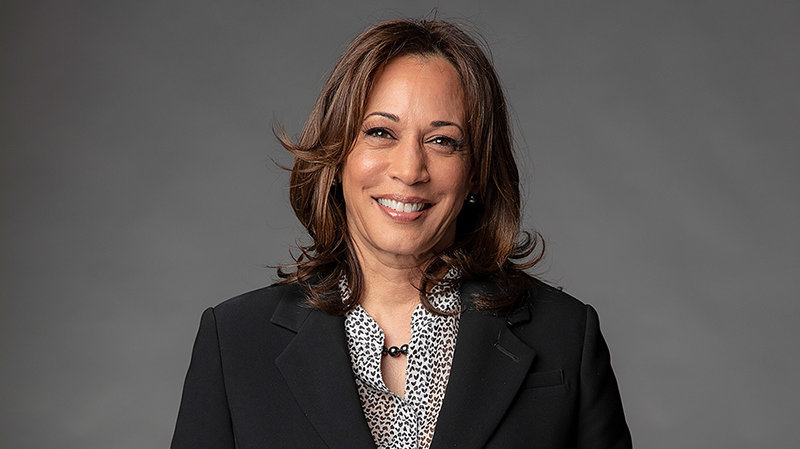
In a historic decision announced last week, Kamala Harris is to be Joe Biden’s running mate for the 2020 presidential election. While there was incredible speculation as to who his running mate would be, many political analysts and commenters suspected that Harris would be the most logical decision (despite the sometimes heated exchanges between the two during the Democratic debates earlier in the year).
Harris is the second black woman to be on a major party ticket for national office, and the first Indian-American.
Kamala Harris was one of four finalists for the position (those not chosen include Senator Elizabeth Warren of Massachusetts, Governor Gretchen Whitmer of Michigan, and Susan E. Rice). Harris comes to the position highly qualified as a public servant and debater, and despite their previous misgivings, it appears that former-Vice President Biden’s choice in running mate was highly calculated.
The Biden campaign’s promise to choose a woman as the potential vise president came for a number of reasons, but without question, one of those reasons was to appeal to a larger voting field. Many were expecting former national security advisor Susan E. Rice to be the most logical choice, but the Biden campaign ultimately found her to be too inexperienced for this particular role. While the other two candidates for running mate were both qualified and loved by many, each of them would have resulted in an all-white ticket; such a ticket would have likely been detrimental to Biden’s campaign.
Biden has hinted that each of the other three women considered would have other roles in his administration if elected, and many are speculating that Elizabeth Warren may be in the running for Secretary of State.
The polls are still favoring Joe Biden and Kamala Harris for the November election, but there is still work to be done by their campaign to secure the election. Mere minutes after the announcement, right-wing commentators began attempting to pick apart Harris’ identity both as a public official and as an American; many conservatives have begun to sing a familiar tune that questions Harris’ birth records and citizenship, as well as her identity as a black Indian-American. Both the Associated Press and the National Public Radio have released fact-check articles that have dismissed these thinly-veiled prejudiced sentiments outright, but that has not stopped the onslaught of criticism that Biden and Harris have received from the right wing.
Regardless of the criticism she’s received since being named Biden’s running mate, Kamala Harris’ resume speaks for itself: she is highly qualified, highly competent as a debater, and has a long history of public service. There is no doubt that she will prove to be invaluable to Biden’s campaign.
For a good part of this pandemic, there has not been much help for the landlords of Arizona, though, they are equally suffering the weight of the financial burden of the COVID pandemic as their tenants. Starting last Wednesday, Governor Ducey announced that he will free up $5 million dollars for the Rental Property Owner Preservation Fund for financial assistance for the landlords of Arizona. CIMA Law Group will explain what it entails to get assistance from the relief funds and summarize how landlords feel about this.
Governor Doucey stipulates The Rental Property Owner Preservation Fund will have help landlords with funds around $5 million, with each landlord eligible to receive up to $50,000. There’s also a cap at five months of rental income up to $2,000 per month per unit. To access such found the landlord must:
small rental property owners, owning up to five single-family properties or up to twenty total units in a multi-family property;
large rental property owners, owning more than five single-family properties or more than twenty total units in a multi-family property;
and whose tenants have not paid rent or have not received rental assistance for the months in the unit for which they are seeking funding.
The biggest thing to note as well the property does not need to be at risk of foreclosure for a landlord to qualify for assistance. However, many landlords believe $5 million is not enough funds for the landlords of Arizona and that many will lose millions in the process. A property owner from Mesa who has two properties asked for a $50,000 loan and stated that even if they do not get paid by their tenants, landlords like himself still have liabilities, still have loans to pay, have insurance, as well have their own payroll and still they will need to maintain the property.
Recently many landlords such as The Arizona Multihousing Association, Manufactured Housing Communities of Arizona, and several rental housing owners filed the special action on Wednesday against Governor Ducey for this eviction moratorium citing unconstitutional act by him.The Arizona Multi-housing Association as well indicated that Arizona assistance system has not been beneficial for both tenants and landlords as the funding has received more than 20,000 requests for nearly $11 million in assistance for renters and property owners since April, but only 7% of those applications have been approved. Less than $2 million has been deployed. As well The AMA President LeVinus said “The eviction moratorium has created a rent holiday for thousands of renters, while property owners still have a mortgage and taxes and bills to pay – including utility bills for many residents who are paying no rent,”.
The duration of the program, however, highly depends on how long unemployment due to the COVID-19 pandemic remains. Executive action holds that the federal relief program for unemployment is available for eligible unemployed Americans:
until Sunday, December 6, 2020, or
until the Department of Homeland Security’s Disaster Relief Fund balance drops to $25 billion
Since the beginning of the COVID-19 pandemic, there has been an incredible push for a vaccine against the virus to be made widely available across the world. Countries like the United States have been opening businesses prematurely in order to return to normalcy, but with the reopen has come an overwhelming surge of new cases; this surge has only increased the demand for a safe and effective vaccine.
While many pharmaceutical companies are working tirelessly to develop the vaccine, the most prominent manufacturer has become Moderna, a Cambridge, Massachusettes-based company. Moderna was awarded $483 million from BARDA that was allocated for research and development of the COVID vaccine. They’ve been working closely with the National Institute of Allergy and Infectious Diseases, and they’ve anticipated spending an additional $410 million on research and the phase three clinical trial which began on July 27th.
The phase three trial involves 30,000 volunteers to test for safety and effectiveness, and Moderna expects the vaccine to be administered in two parts for maximum protection against COVID-19. Should the trial process go as planned, and as long as Moderna receives the amount of volunteers they need to proceed, the vaccine could be ready for production by January 2021. This would be the fastest vaccine development timeline in history.
Moderna, Pfizer, and Johnson & Johnson are the major biotech and pharmaceutical companies that have COVID vaccine deals with the US government, but for many, a major concern is the price of the vaccine. The presidents of both Moderna and Pfizer have announced that they would not sell the vaccines at the cost of production, and project that the two-dose vaccine could cost around $30 per dose. While this might sound cheap to some, it could leave those in a financial hard spot without the means to vaccinate themselves and their families. Because of the disproportionate rates of poverty in black and brown communities, the cost of the vaccine could perpetuate the high rates at which COVID-19 is affecting minority communities.
Enter the Gates Foundation: the Bill and Melina Gates foundation has decided to financially back the Serum Institute of India in their production of a COVID-19 vaccine. The goal of this partnership is to supply the vaccine to low- and middle-income countries and communities, and produce 100 million vaccines at $3 per dose.
Whether the vaccine is made available next month or next year, there is some concern about the potential greed of pharmaceutical distributers in the cost of each dose. While the federal government is financially funding the research and production of the vaccine, it is still up for debate whether the vaccine will be affordable for all Americans.
Trigger Warning: This article contains a story involving police brutality
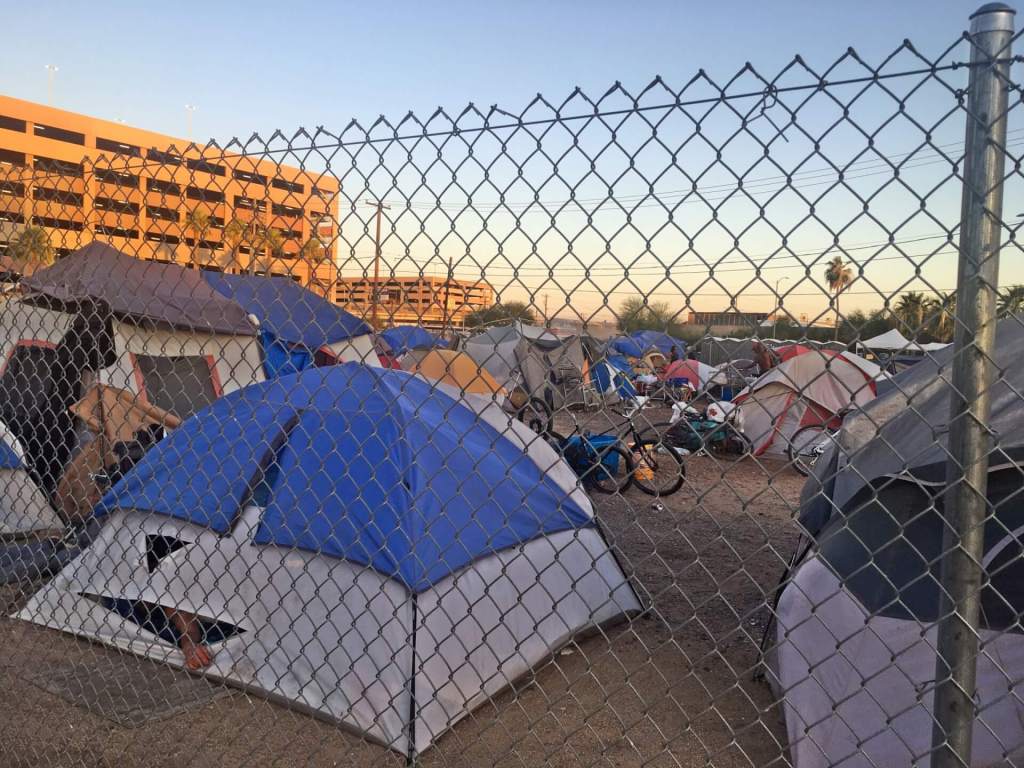
Photo of a parking lot “shelter” located roughly between Eighth and Ninth avenues from Madison to Jefferson streets. Photo by Madeline Ackley | Arizona Mirror
Of the 7,419 people experiencing homelessness in Maricopa County, more than half of them are unsheltered and sleeping on the street – enduring both extreme heat and increased exposure to coronavirus. Experts expect that number to rise significantly with the current economic downturn.
Meanwhile, the major shelter in Phoenix, the Human Services Campus (HSC), reports that it’s currently only able to house 390 adults with COVID-19 precautions in place. In an attempt to create more designated sleeping spaces, Maricopa County and the HSC have resorted to crowding unsheltered people into asphalt parking lots. City spokeswoman Tamra Ingersoll says that the lots technically count as shelter spaces since people living on the lots “are connected to case management and with provided services of water and bathrooms [port-a-potties] and designated space.” However, the lots themselves lack shade and are plastered with signage that read “temporary outdoor space.” The chain-link fences and armed security guards don’t help make the spaces any more inviting.
Those who refuse to live in the parking lots may be subject to arrest. In 2018, the 9th Circuit Court of Appeals banned police from ticketing or arresting people for sleeping in public when there are no alternatives to shelter, citing it as cruel and unusual. However, Phoenix city police have been using the lots’ existence as a loophole to continue to arrest and ticket people by claiming that there is available shelter. Nadeen Bender, for instance, was recently ticketed for “camping on city property” as she lay under a bush trying to recover from heat exhaustion caused by the 110-degree Fahrenheit day. She told the Phoenix New Times that it already takes around ten hours a day just to get around, get food, and get everything else she needs to survive while keeping her things safe. The ticket has been distressing for her because she doesn’t know how she will find the time or transportation to get to court.
The Human Services Campus has submitted a special permit re-zoning request to add additional beds and expand their campus boundaries, and since then, the City of Phoenix has drafted a new homelessness plan. While there are aspects of the plan that are universally agreed on as helpful – such as increasing the number of beds in shelters and increasing funding for mental health services – advocates for homeless people say the plan criminalizes people who don’t have access to shelter.
Crackdowns listed in the plan include: replacing bus benches with chairs, implementing more gates and fences around the Human Services Campus, shutting down the unlicensed distribution of food to homeless people, working with federal authorities to remove people along the Grand Canal, and establishing a universal code of conduct that facilitates banning homeless people from city property like community centers and libraries.
Advocates are worried most about how the plan centers police as the primary responders to calls for service, homeless outreach, and public property cleanups. Phoenix only requires a total of 720 hours of training to become a certified police officer and that training centers on firearms, physical conditioning, and law enforcement instruction. Meanwhile, Arizona requires a bachelor’s degree, a master’s degree, and a minimum of 3200 hours of supervised field experience to become a licensed social worker. In short, Phoenix police are being asked to perform the same duties as a social worker and mental health professional with only a fraction of the training.
This decision has proven to be deadly. Phoenix has grappled with accusations of police brutality for the last several years, yet it is one of the largest police departments in the country without civilian oversight. In 2018, it led the nation in fatal officer-involved shootings, with 23 deaths.
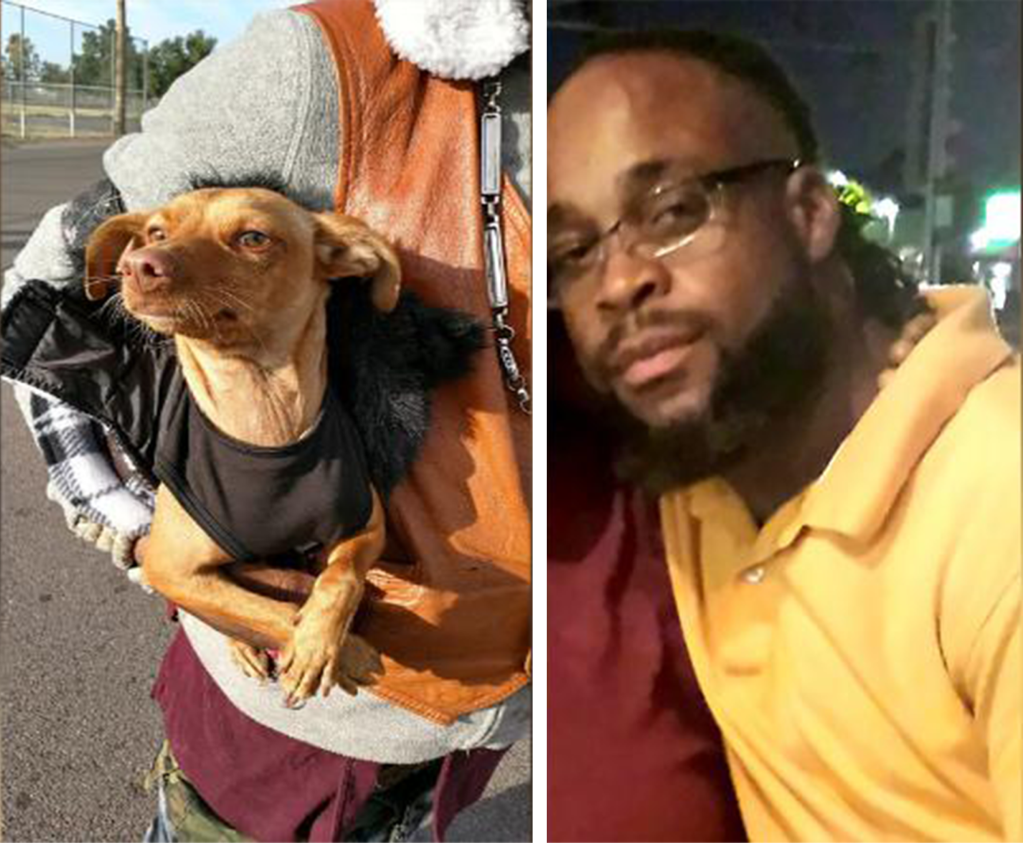
In 2017, Phoenix had an incident nearly identical to that of George Floyd. It began when a black homeless man, Muhammad Muhaymin Jr., tried to carry his emotional support dog, a Chihuahua named Chiquita, into the restroom of a community service center. The manager physically blocked him and told him to leave the dog outside and when an argument ensued, the manager instructed an employee to call the police. When they arrived, three Phoenix police officers arrested him and wrestled him to the pavement, Chiquita ran around scared, and Muhaymin called out for his dog, saying, “That’s my child, officer.” One officer pinned his head to the pavement with a knee, while the others kneeled on his neck and shoulders as he screamed out “Please Allah” and “I can’t breathe!” until, after eight minutes, he went limp. Muhaymin died soon after – a little more than an hour after he had walked into the community center to use the public restroom.
Muhammad Muhaymin Jr. and his dog Chiquita
In the three years since then, none of the officers responsible for Muhaymin’s death have faced any discipline; all remain on the force and one is now a detective. Since there is no external oversight, the Phoenix Police Department conducted its own investigation into the case and said that “none of the officers’ actions on that day were found to be ‘out of policy.’”
Muhaymin’s death is one example of a larger trend. A disproportionate amount of people without shelter in Phoenix – around 30 percent – are black, in a city that is only around 7 percent black. At the same time, police use of force is among the leading causes of death for young men of color. By centering police as key implementors of its current and proposed plans on addressing homelessness, the City of Phoenix not only criminalizes homelessness but directly puts black lives at risk.
Phoenix’s proposed plan on “Strategies to Address Homelessness” is still receiving public input until August 28th before it goes into effect. To leave comments or concerns, follow this link. (Para compartir este articulo con gente hispanohablantes, oprima este enlace en Español.)
Edwards, F., Lee, H., & Esposito, M. (2019, August 20). Risk of being killed by police use of force in the United States by age, race–ethnicity, and sex. Retrieved August 05, 2020, from https://www.pnas.org/content/116/34/16793
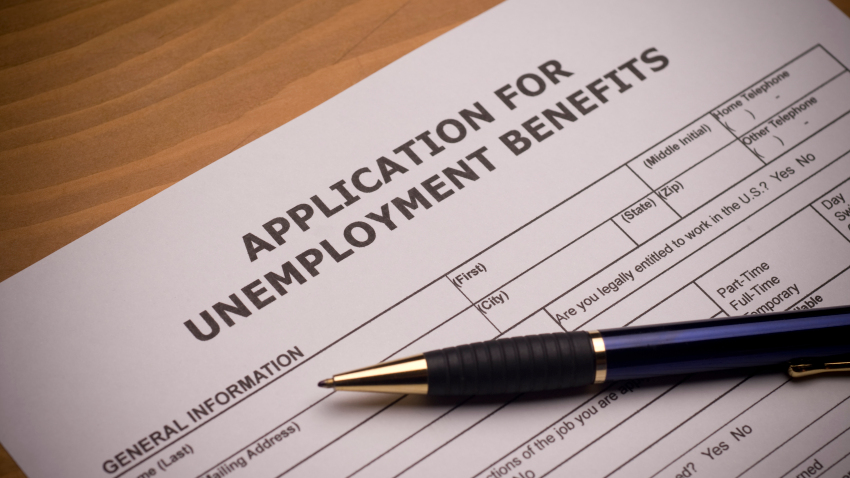
While Democrats favor the continuation of the $600 relief program into 2021, Senate Republicans favor deducing the amount Americans receive from the stimulus relief program and are even considering the idea of including bonuses for those who accept job offers, due to concerns that unemployment benefits are an incentive for the unemployed not to return to work. An investor in a sandwich shop in Buford, Georgia expressed,
If the government is paying more to stay home, why would those people be out there risking their lives, number one, number two, staying away from their families and number three, making less money?
Consequently, more Americans across the nation are relying on unemployment benefits, which are, in turn, showing as a factor in a weakened economy. Although unemployment is presenting itself as more of an advantage than a disadvantage, the risk of the relief program being misused is a thought running through Senate members’ minds. “Jobless Americans can’t turn down positions and continue to collect unemployment benefits — unless they meet the criteria to qualify for a temporary pandemic program that Congress created to help those directly affected by the Corona virus.”
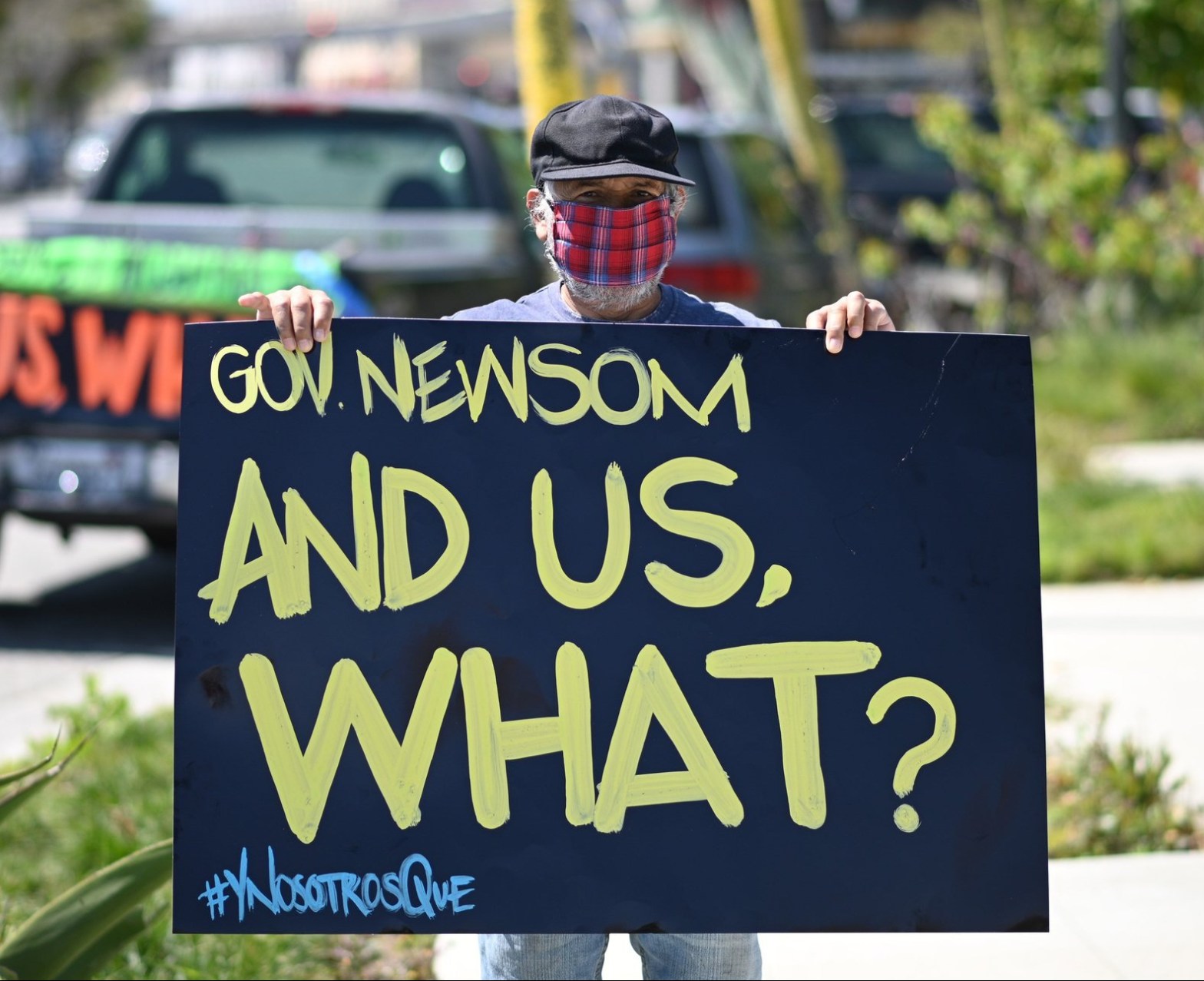
Immigrants without legal status in California have been hit hard by the impacts of the COVID-19 pandemic. Like millions of other Americans, they have lost jobs, wages and some have even lost their homes due to shutdowns and the economic fallout of the virus. In order to provide support to these communities, the governor of California, Gavin Newsom pledged in April to send at least $500 to around 150,000 immigrants in California with the Disaster Relief for Immigrants program. Twelve nonprofits were given state contracts to oversee and distribute the payments.
Its been three months later and only half of the original 150,000 people have received their payments. Clearly the California government has larger concerns and did not expedite this process. The scale of the issue is also very large and the twelve nonprofits selected to run the program have been woefully unprepared for the amount of claims they’ve received. The root problem is that the people in these undocumented communities cannot apply for regular CA state unemployment, which has doled out millions already to Californians who have a citizenship.
In response to the lack of aid, hundreds of nonprofits and humanitarian groups around the country have rallied behind these immigrant communities by raising money for their benefit. One such group, the Grantmakers Concerned With Immigrants and Refugees has already raised around $50 million dollars to contribute to the program.
There have been calls within the California Legislature to increase the amount of money being given with each payment. Many have argued that $500 is not enough to feed families and pay rent. The allotted $500 is far less than what Californian citizens make from state unemployment. As the pandemic continues, more attention must be given to these communities in order to provide adequate economic aid.



 CIMA Law Group Blog