What is the UN Trusteeship

Background

The Trusteeship Council was formed by the UN Charter as one of the principal UN bodies, and it was given the responsibility of overseeing the management of Trust Territories put under the International Trusteeship System. The International Trusteeship System’s primary objectives were to support the development of Trust Territory citizens and their gradual transition to self-government or independence. The five permanent members of the Security Council—China, France, the Russian Federation, the United Kingdom, and the United States—make up the Trusteeship Council. To the degree that all Trust Territories have achieved self-government or independence, either as separate States or by joining other nearby sovereign countries, the objectives of the Trusteeship System have been achieved.United Nations

International Trusteeship System

In 1945, the United Nations established the International Trusteeship System for the supervision of Trust Territories placed under it by individual States administering them. The basic objectives of the Charter included: to promote the political, economic, social and educational advancement of the inhabitants of the Trust Territories and their progressive development towards self-government and independence. In 1993, the last Trust Territory to do so was the Trust Territory of the Pacific Islands (Palau) under the administration of the United States. With no Territories left in its agenda, the Trusteeship Council suspended its operations on 1 November the same year.The United Nations and Decolonization

Some achievements of the UN Trusteeship Council

When the United Nations was founded in 1945, 750 million people lived in territories that were dependent on colonial powers. Chapter XII of the UN Charter established an international trusteeship system. The Trusteeship Council was instrumental in the decolonization and subsequent independence of 11 trust territories in Africa and the Pacific. Most of the Council’s active years are from before UN documents were issued in electronic format.Digitization Update – Trusteeship Council

Why are Europe and Asia associated with one another?

Asia-Europe trade

Trade between ASEM countries accounts for about half of all world merchandise trade, with two major hubs: Germany and China. Germany is responsible for one-quarter of the overall business in the ASEM group and is the leading trade bridge between the two continents. China is the largest customer, with over half of its European exports delivered to Germany, The Netherlands, and the UK. Russia is the third largest trader, exporting twice as much to Europe as Asia. Significant Asia-Europe trade flows of more than $100 billion exist between Europe, Japan, Korea, and India. Diplomatic relationships are strong, and links via trade agreements and embassies are associated with greater bilateral trade intensity. 2019 saw a new trade agreement between the EU and Japan coming into force, which includes provisions on sustainable development. Explained, the economic ties between Europe and Asia

After 1945, Europe and Asia’s pathways toward economic union were distinct. In contrast to Asia, which lacked solid economic integration agreements, Europe had a monetary union with free movement of commodities and factors of production and a single currency by 2000. Asian nations have become more engaged in detailed trade agreement negotiations since 2000, a distinctive aspect of open regionalism. Greater economic integration of countries looking to gain from globalization in Europe and Asia will result from the convergence of the EU’s external trade policy and the policies of many Asian nations toward a model of liberal trade regimes.Different Paths to Economic Integration in Europe and Asia

THE EU AND ASIA: CONFLICTING INTERESTS AND CONTRASTING WORLDVIEWS

There are long-standing disagreements regarding principles and standards between the EU and its Asian allies and worries about protectionism and intellectual property rights. For example, the EU is pressing for legally enforceable reductions in CO2 emissions, whereas ASEAN is asking for flexibility. In addition, the EU and ASEAN have divergent views on state sovereignty and international law.The Strength of Distant Ties: Europe’s Relations with Asia in a Changing World

3 Plant-Based Snacks to Power You Through Midterms

Constantly on the go during the midterm season? Here are three plant-based snacks to boost your energy and help you beat the mid-semester blues.

The Best No-Bake Cookies

While there are many ways to make incredible no-bake cookies, my favorite recipe is the Love & Lemons No Bake Cookies recipe. After years of being a massive fan of no-bae cookies, this recipe has come in handy throughout long work days and busy school semesters. Plus, you can double the batch and freeze the rest! Saving them for a rainy day or a last-minute library trip.

Vegan Taquitos

These easy vegan taquitos are a great savory late-night snack for at-home and group study sessions. These rolled tacos are full of lentils and are high in protein, but my favorite taquito recipe Kathy’s Vegan Kitchen Vegan Taquitos, offers multiple filling options to satisfy any preference.

Mini Muffins

For me, Mini Blueberry Muffins (with a bit of lemon) are a lifesaver for a quick mid-morning snack. Easy to pack up in a lunchbox or, if you’re feeling brave, wrap in plastic and keep in your jacket pocket, these tiny muffins are ideal for on-the-go eating. My preferred recipe is the Mini Vegan Lemon Blueberry Muffins from Breaming Baker. It’s quick, easy, and delicious!

This blog post is part of the CIMA Law Group blog. If you are located in Arizona and are seeking legal services, CIMA Law Group specializes in Immigration Law, Criminal Defense, Personal Injury, and Government Relations.

What is debt celling and what it would happen if the U.S hits debt celling?

What is the debt ceiling?

The debt ceiling, which Congress established in 1917, sets the maximum amount of outstanding federal debt that the United States government may accrue. What Happens When the U.S. Hits Its Debt Ceiling? This Means that Congress can limit the amount the US government can borrow to cover its costs. The debt ceiling is the name given to this cap, which currently stands at $31.4 trillion. The federal government uses borrowing to cover expenses included in its budgets, such as social security and Medicare payouts and the salaries of US military personnel. What is the US debt ceiling and what happens if it isn’t raised?

What happens when the U.S hits the debt ceiling

According to some experts, that would spell turmoil for American and world economies. In addition, hitting the debt ceiling would make it difficult for the government to pay for operations, such as paying for the national military or entitlement programs like Medicare and Social Security, even if there was no default. What Happens When the U.S. Hits Its Debt Ceiling?

Options to avoid a crisis?

Federal Reserve chair Janet Yellen has announced a plan to avoid the US government going over the debt ceiling. Prioritizing some payments, such as military wages, or postponing payments entirely for a while have been proposed. Either scenario would disrupt the financial markets and result in legal issues. The U.S. Hit the Debt Ceiling. What Does That Mean and What Happens Now?

The Science of How People Are Exposed to New Diseases

Whats Zoonotics? How do people come into contact with it?

Zoonotic is the term for harmful germs that animals carry, then humans come into contact with these germs to cause viruses, illnesses, and diseases. The connection how people get infected is from direct contact, indirect contact, vector-borne and foodborne.

The Black Plague is a well-known example. Yersinia pestis is the bacteria transferred from fleas to humans. Rodents were vectors for this disease, lurking in the main food supplies and exposing people to fleas.

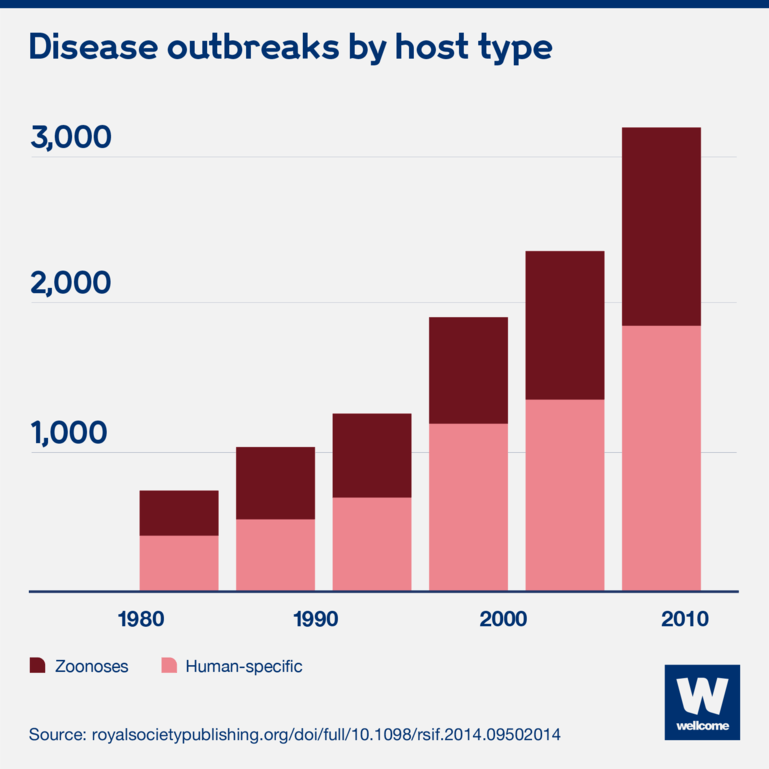
The chart above represents comparisons of the number of Zoonoses (Zoonotic) outbreaks versus Human-specific outbreaks.

The rising number has many factors:

Global warming causes animals to move into new geographical areas where humans reside. Exposing others to new unknown diseases.

Food production has a number of reasons why this is a possible factor. The reasons range from unnatural agricultural conditions to wildlife trades and consumption.

Travel and Transportation increase the odds of diseases traveling unknowingly across the globe. Monkeypox is another example of how the viruses traveled from South Africa to America. Wild African animals were housed alongside prairie dogs. The infected prairie dogs mated and infected the colonies, causing a rippling effect. People across the U.S. unknowingly keep infected prairie dogs as pets. 

Surveilling and monitoring the diseases is how scientists help combat these diseases. It is up to people to be aware of their own health. It is our responsibility to be aware of what is happening within a country before visiting and to read the local media.

There is also a virtual exhibit at the Smithsonian National Museum of Natural History.

This blog post is part of the CIMA Law Group blog. If you are located in Arizona and are seeking legal services, CIMA Law Group specializes in Immigration Law, Criminal Defense, Personal Injury, and Government Relations.

California budget faces deficit: Newsom proposing spending cuts to balance the budget

Background

Although the CA State government honed a budget surplus of nearly $100 billion dollars six months ago, it is now facing a budget deficit of $22.5 billion because of spiraling inflation and a weakening stock market, which is problematic given that the budget relies heavily on capital gains from CA’s wealthiest residents. Therefore, to balance the budget (required by state law), the Newsom administration is proposing to delay previously funded expenditures and cut spending for infrastructure, safety net expansions, public health, arts education, housing, prisons, and workforce programs.

Delayed Expenditures

Newsom’s budget proposal would delay $7.4 billion in spending to future budget years and shift $4.3 in appropriations to other sources, such as construction project on CSU’s campuses that would now be paid for with state bonds. It would also eliminate $5.7 billion in previously funded expenditures, including $3 billion to address inflation and $750 million to pay down the unemployment insurance debt that was accrued during the COVID pandemic.

Spending cuts

Newsom’s budget proposal also proposes to make $3.9 billion in trigger cuts that could be reversed within the next fiscal year if the state has enough money to pay them off. These cuts primarily focus on climate transportation, where zero-emission vehicle credits and infrastructure programs are to receive $2.5 billion less from the general fund and rail and transit projects are to receive $2.2 billion less. Related to college and university infrastructure, Newsom would delay $1.15 billion in new affordable student housing money, while the planned $900 million for an interest-free loan program to build housing on college campuses would instead be funded in the 2025-2026 fiscal year. Furthermore, the $83 million dollar appropriation to upgrade the campuses of UC Merced and UC Riverside would also be delayed until 2024-2025.

Social Safety Net

Related to the social safety net, the proposal to expand food assistance to older undocumented immigrants would instead be funded in 2027, rather than later this year as initially proposed.

Public Health

Concurrent with public health, Newsom proposed a $1.2 cut to the California Department of Public Health. Most of the decrease comes from a $614 appropriation of COVID-19 emergency relief dollars that will instead be placed in the general fund. New public health workforce training programs would also receive a $50 million cut, leaving only $25.8 million to train microbiologists, epidemiologists, and public health nurses.

Arts Education

Concurrent with arts education, the governor has proposed to cut $1.2 billion of one-time discretionary funding for arts and instructional materials.

Housing

Newsom’s proposal would cut $350 million dollars from housing programs aimed at assisting first-time homebuyers and boosting affordable housing. Additionally, $200 million would be cut from a previously budgeted $500 million program named “Dream for All,” which is a fund that provides down payment loans to low and middle-income homebuyers.

Prisons

To save the state $150 million this budget cycle, Newsom’s proposal would close down individual wings within six state prisons.

Workforce Programs

Newsom also proposed to cut a planned $25 million investment in outreach to workers and employers in industries with high COVID risk and $40 million over the next two years for non-traditional apprenticeships.

To read the full summary of Newsom’s budget proposal, please click here.

9 Quick and Easy Vegan Recipes

Did you set the goal to eat less meat in 2023? Maybe you’re trying something new, or maybe your Veganuary challenge is carrying on into February–either way, here are 10 quick and easy vegan recipes for your week!

Breakfast

BREAKFAST HASH – This 25-minute recipe has only 10 ingredients and is an excellent option for a fast and filling breakfast or as a filling to a breakfast burrito or casserole.

SIMPLE PANCAKES – This simple recipe calls for 6 common ingredients, which can all be mixed in one bowl for easy clean-up. This recipe is perfect when topped with maple syrup and strawberries, but I recommend adding vegan whipped cream on top!

CREPES – This recipe is a household favorite, and it’s easily customizable. Fill with peanut butter, chocolate spread, jam, whipped cream, or fresh fruit, and enjoy!

Lunch

HUMMUS WRAPS WITH RAINBOW VEGGIES- This fun and colorful veggie wrap is full of plant-based protein and can be customized based on the produce available/in season.

BLACK BEAN AND AVOCADO QUESADILLAS – These protein-and-fiber-powered quesadillas also go perfectly with the Lemons and Zest Mango Avocado Salsa.

SPICY POTATO KALE BOWLS – Topped with a mustard tahini dressing, these bowls are a vegan staple.

Dinner

LEMON PASTA – This quick, budget-friendly dinner is a must-try for busy weeknights.

MUSHROOM STROGANOFF – This hearty meal is perfect for the lingering winter chill, and the mushroom sauce can be served over rice, quinoa, mashed potatoes, or (my favorite) your choice pasta noodle.

CREAMY TUSCAN ORZO – This recipe is quick to make and flavorful! If you’re tired of your flavor routine, this recipe is for you!

This blog post is part of the CIMA Law Group blog. If you are located in Arizona and are seeking legal services, CIMA Law Group specializes in Immigration Law, Criminal Defense, Personal Injury, and Government Relations.

California passes new pay transparency law: What is it?

What is CA SB 1162 and who is affected by it?

On September 27,2022, Gov. Newsom and the CA State Legislature passed SB 1162, which is a new state law that would require employers to disclose the pay scales for their job postings. Starting on January 1, 2023, employers with at least 15 workers will be mandated to provide such information, whether it is through a third-party or through their own platform. In the event that an employer fails to meet such an obligation, an aggrieved worker can file a written complaint with the Labor Commissioner within a year after the violation. In the event that the labor commissioner finds the employer guilty, they will be mandated to pay a civil penalty ranging from $100 and $10,000 per violation.

On the other hand, private employers with 100 or more labor contractors and employees will be mandated to report a more detailed pay data report to the DFEH, which includes the median and mean hourly rate within each job category for each combination of race, ethnicity, and sex. This report would apply to all job positions, whether that is executive positions or managers, professionals, technicians, sales workers, etc. Employers with multiple establishments will be required to submit a separate pay data report for each establishment. For such a report, the DFEH would prohibit the publishing of any information that includes a specific individual. For an employer that fails to file the extensive report, the court could impose a civil penalty of not more than $100 per employee and not to exceed $200 for a subsequent failure.

For the full bill, please click here

Different Cultures: Cinephile

Have you ever just sat and binged three movies in one day and knowledge this is a constant recurrence. Well, you’re most likely a Cinephile. What is a Cinephile? Someone who is passionate about films, also known as a movie buff. The culture ranges from contemporary Cinephila to Telephilia.

The term originated from post-WWII Paris since the city was known to have more access to a broad range of films from all over the world. During this time period movie goers, bought a ticket while the film was playing then stay seated for it to start over again, and it was culturally appropriate to talk in between the film. One specific film changed this regular practice, Alfred Hitchcock’s Psycho (1960), as he wanted to marginalize from his master peace. Thankfully, those movie theater behaviors did not travel into the 21th Century. Most audiences do not want to hear what you rant about if you’re Team Jacob or Edward from Twilight (2008).

Cinephiles walk among us and travel across the world to see their favorite on-screen artists win the well-deserving awards or buy seats to premiers featuring their favorite film companies. Sundance Film Festival is one of the notorious gatherings for movie buffs featuring film production companies such as A24 known for HBO’s TV series Euphoria (2019)and Everything Everywhere All At Once (2022). Even small international independent film makers, have had their big breaks at Sundance, show casing Napoleon Dynamite (2004), directed by Jon Heder.

Many changes have happened in this art form, from black-white screening to VHS tapes to now streaming services. Neither the less, there will always be a place for passionate people, either across the world or on the internet.

This blog post is part of the CIMA Law Group blog. If you are located in Arizona and are seeking legal services, CIMA Law Group specializes in Immigration Law, Criminal Defense, Personal Injury, and Government Relations.

Dear Hank and John: A Podcast Review

Produced by WNYC Studios and Complexly, Dear Hank and John is a humorous and heartfelt podcast where two brothers, John and Hank Green, answer listener questions, offer dubious advice, and give you all the week’s news from Mars and AFC Wimbledon.

The podcast focuses mainly on answering the important questions that we all find ourselves wondering. 

Questions like, 

“Is it OK to go to your old house and ask if you can walk through it?”

“Are the bees OK?”

and “What do you do if your dentist tries to talk to you when you obviously can’t talk?”

This incredible podcast carries a sentimental sweetness unmatched in the podcasting world. Each episode conveys a deep appreciation for the beauty of the world around us and the good that John and Hank know that people are capable of. 

This podcast is a one-stop-shop for anyone who is feeling hopeless or discouraged about the state of the world, seeking a deeper appreciation for the Anthropocene, or just wanting to learn more about the English professional football team AFC Wimbledon.

All 358 episodes that are currently released for Dear Hank and John can be found anywhere you get your playlists. 

This blog post is part of the CIMA Law Group blog. If you are located in Arizona and are seeking legal services, CIMA Law Group specializes in Immigration Law, Criminal Defense, Personal Injury, and Government Relations.

Design a site like this with WordPress.com
Get started