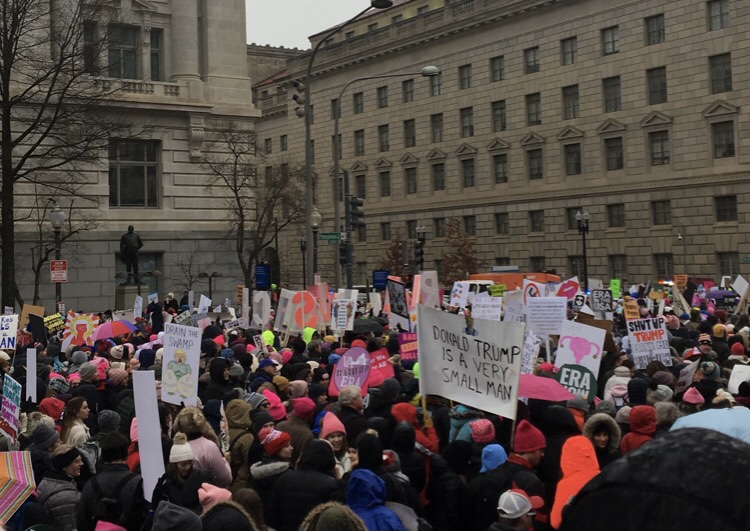
In 1973, the Supreme Court provided a ruling in Roe v. Wade that upheld women’s right to have abortions. Although the decision was somewhat restrictive about the conditions required for abortion, it nonetheless served as not only a landmark decision for abortion rights, but for women’s right to privacy. It set the precedent for women’s ability to make reproductive choices for themselves, and has continually been reaffirmed in cases following it such as Planned Parenthood v. Casey (1992). Despite this clear foundation for women’s right to reproductive choice in the United States, recent events have significantly threatened this foundation and brought into question the extent to which the United States truly protects women’s reproductive rights and the extent to which these rights will remain intact in the near future.
Early last week, whistleblower Dawn Wooten, a nurse at the Irwin County ICE Detention Center filed a complaint expressing concerns about the high number of hysterectomies being performed without proper consent within ICE facilities. This issue came to light amidst reports of Immigration and Custom Enforcement’s refusal to enforce proper COVID-19 regulations and provide adequate testing. Although investigation is underway, the claim that ICE is performing mass hysterectomies has not yet been validated. However, issues concerning women’s health, including a lack of prenatal care, at ICE facilities have been reported for years now. Additionally, Project South, the organization that helped Wooten file her complaints makes a powerful point about the importance of these reports. The underlying issue here is the lack of proper informed consent. Detainees reported being confused about their medical procedures and why they received them, indicating a clear lack of informed consent for the hysterectomies and other operations they received.
Informed consent, especially in the case of procedures relating to female reproductive capabilities, should be an obvious prerequisite for treatment. In an era when the United States claims to uphold women’s reproductive rights, it is nothing short of inhumane for ICE, a United States executive agency, to perform procedures that inhibit women’s reproductive ability without their proper informed consent. The recent reports of unwilling sterilization in ICE detention centers have evoked comparisons to the 20th century when the United States had government-sponsored forced sterilization programs across 33 states. In both cases, we see that the groups disproportionately impacted were those who were primarily low-income individuals and people of color.
These allegations of mass sterilization by Immigration and Custom Enforcement have arisen at a contentious time for women’s reproductive rights within the United States. With the passing of Supreme Court Justice Ruth Bader Ginsburg, there is potential for a 6-3 conservative majority within the Court. This conservative majority could prove problematic for a couple of reasons. First, President Trump has indicated in the past that his pick for Supreme Court Justice will likely be a pro-life individual with the determination to overturn Roe v. Wade. In the case June Medical Services LLC v. Russo (2019), Justice Neil Gorsuch and Justice Brett Kavanaugh, both Trump appointees, sided with conservatives, against the abortion providers. It is likely that if the Trump Administration is able to confirm a third justice before the end of the term, it will be another individual with an anti-abortion ideology. Second, another conservative on the Court increases the chances that even if Roe is not overturned, reproductive choice rights can be limited via narrower laws and new cases that present non-abortion reproductive rights issues. At the moment, with the Supreme Court vacancy in the hands of the Trump Administration and Senate Republicans, the fate of women’s reproductive rights hangs in the balance.
Feinberg, A. (2020, September 23). Trump’s Supreme Court pick could challenge Brown v Board of Education. Retrieved September 26, 2020, from https://www.independent.co.uk/voices/trump-supreme-court-pick-ginsburg-amy-coney-barrett-roe-v-wade-brown-v-board-education-b535886.html
ICE whistleblower: Nurse alleges ‘hysterectomies on immigrant women in US’. (2020, September 15). Retrieved September 26, 2020, from https://www.bbc.com/news/world-us-canada-54160638
More detained immigrant women say they didn’t approve surgery. (2020, September 18). Retrieved September 26, 2020, from https://www.cnbc.com/2020/09/18/more-detained-immigrant-women-say-they-didnt-approve-surgery.html
Project South. (2020, September 14). Lack of Medical Care, Unsafe Work Practices, and Absence of Adequate Protection Against COVID-19 for Detained Immigrants and Employees Alike at the Irwin County Detention Center. Retrieved September 26, 2020, from https://projectsouth.org/wp-content/uploads/2020/09/OIG-ICDC-Complaint-1.pdf
Reuters. (2020, September 23). Explainer: Supreme Court’s Roe v. Wade decision hinged on women’s right to privacy. Retrieved September 26, 2020, from https://uk.reuters.com/article/us-usa-court-abortion-roevwade-explainer/explainer-supreme-courts-roe-v-wade-decision-hinged-on-womens-right-to-privacy-idUSKCN26E1LU
Svokos, A. (2020, September 21). Is Ginsburg’s death the end of Roe v. Wade? This time, some experts say, it could be. Retrieved September 26, 2020, from https://abcnews.go.com/Politics/ginsburgs-death-end-roe-wade-time-experts/story?id=73119646
 CIMA Law Group Blog