Democrats Begin Reconciliation Process

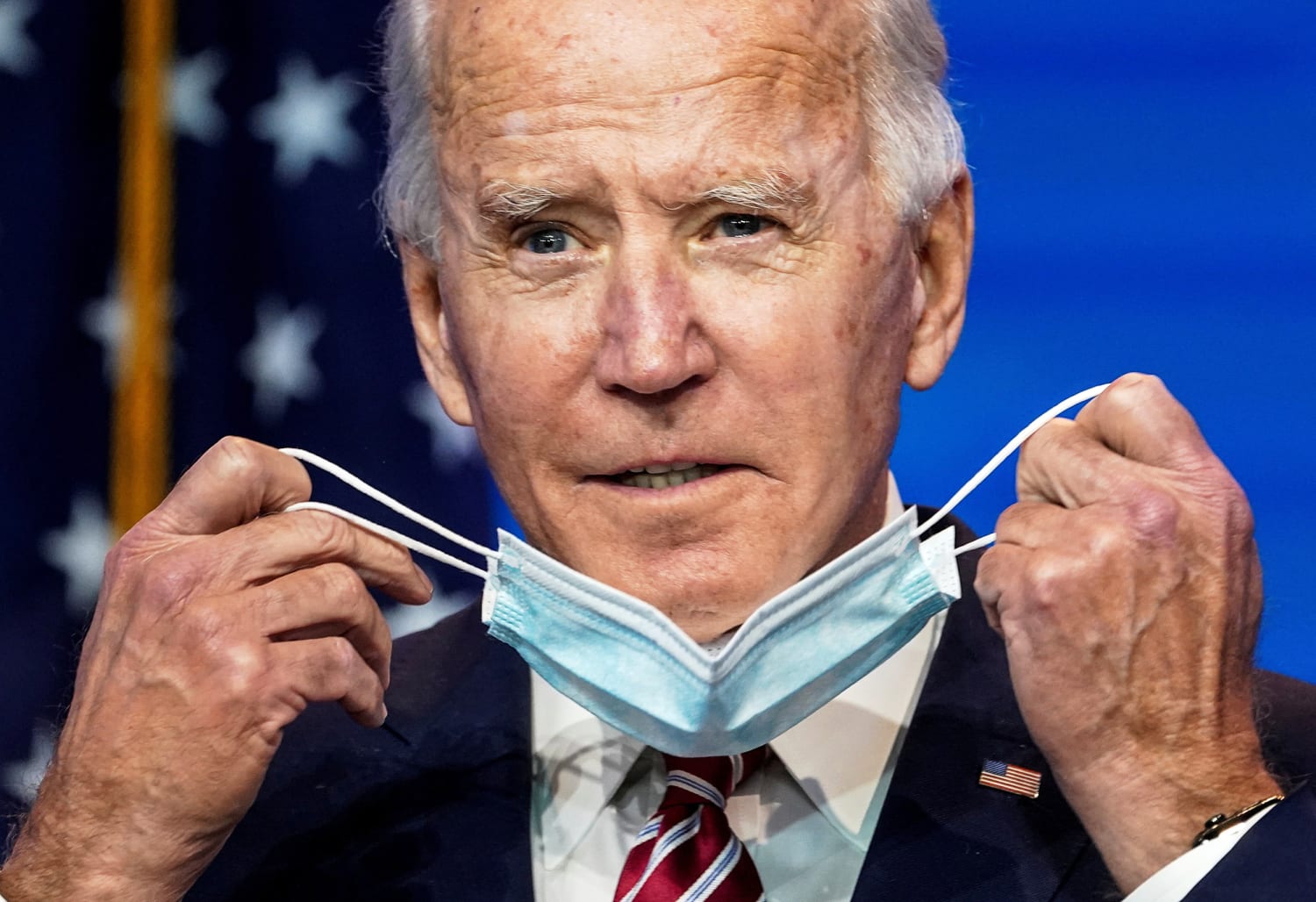
Some positive news have recently come to fruition in regards to the COVID Relief Bill. Pelosi and Schumer have filed a joint budget resolution kicking off reconciliation processes to pass a 1.9 trillion dollar COVID Aid with a simple majority vote. Senate Majority Leader Chuck Schumer, D-New York, articulated his opinion by stating how “Congress must pursue a bold and robust course of action. It makes no sense to pinch pennies.” This statement appears to be reflective of President Biden’s upcoming approach in economic relief. Sen. Joe Manchin appeared on MSNBC’s “Morning Joe” to talk about the state of negotiations over President Joe Biden’s Covid-19 relief package. He had recently spoken to Biden about the path forward, he said, and Biden was quite clear. “He basically said, ‘I don’t want to go down the path we went down in two-oh-nine when we negotiated for eight months and still didn’t have a product and had to do what we’re doing now.’ I said, ‘Fine, Mr. President, I’m happy to start this process.”

Image result for reconciliation democrats

However, there are rumored changes to the Bill that are substantially different than the initial promises made during recent elections from the Democrats. Firstly, speculation has revealed that stimulus checks will be adjusted from $2,000 down to $1,400. Asserting the idea that the total of stimulus payment checks would be 2,000 with consideration of the already distributed $600 checks back in early 2020. Alongside this modification is the reconsideration of applicable Americans to receive these relief benefits. Lowering the criteria for applicable Americans down to an annual salary of $50,000 instead of $75,000 and a subjective phase-in process which analyzes an American’s demand for compensation. Resulting in disproportionate payment distribution depending on a citizens salary rather than overall need. Regardless, reconciliation talks from the Democrats suggest the process will naturally be lengthy in nature in opposition to regular order by gaining enough Republican votes. Ultimately solidifying a considerable amount of time before money reaches the hands of its intended recipients and jeopardizing an appropriate arrival.

Updates on the coronavirus relief package

Since the first day Joe Biden was in office the coronavirus relief package was one of the first proposal’s he made. Despite some of Congress believing that they have done and/ or gave enough to American’s in previous stimulus checks Joe Biden and the majority of Congress disagree. Since democrats are now the majority within the branches of government this coronavirus relief package has relatively good odds of passing and helping more American’s worldwide during this difficult time.

Image result for joe biden

COVID Bill Passed Senate Through Budget Reconciliation: Is This The New Way Forward?

Brady Allardice

Today, February 2, the Democratic majority in the U.S. Senate passed Joe Biden’s $1.9 trillion COVID relief bill, paving the way for the bill to be enacted into law in the near future. While many Americans are understandably excited by the prospect of much-needed aid coming their way, the method that the Congress used to pass this bill has drawn attention in the news. Budget Reconciliation, or simply, Reconciliation comes from the Congressional Budget Act of 1974, which allows Congress to consider changes to tax, spending, and debt legislation. This process was intended to allow Congress to adapt its spending priorities in response to the demands of the day and was mostly used to reduce spending in its early years. It has only been used 25 times since 1974 but has become an important tool in Congress’ ever-shrinking bill-passing quiver in recent years. This is because Reconciliation has one special trait that makes it extremely alluring to the majority party: its immunity from the Filibuster. Budget Reconciliation, once it gets to the Senate floor, only needs a simple majority. In 2017, Republicans used Budget Reconciliation to pass the 2017 Tax Cuts and famously failed in their attempt to use it to repeal the Affordable Care Act, with John McCain casting the deciding vote while battling with cancer.

As citizens and politicians alike becoming more entrenched in their political ideologies, the division among right has grown into more of a chasm. Throughout American history, compromise and bi-partisanship have been key to creating the laws that governm the United States, but now compromise and bi-partisanship is seen in as selling out to the other side. If you don’t believe me, just ask Liz Cheney, who was almost ousted from her party for voting to impeach Donal Trump. So instead of committing political suicide by trying to reach a bi-partisan deal, the Senate is left with two (three) options: remove/reform the filibuster or pass spending measures through Budget Reconciliation (or just do nothing and pass no bills). With the potential deciding vote, Joe Manchin, signaling he would be against removing/reforming the filibuster, Democrats are left only with the latter.

On its face, passing measures through Reconciliation doesn’t seem so bad. So what if Democrats use it instead of passing filibuster reform? Isn’t it effectively the same thing? Couldn’t each majority party just do this until the political animosity somehow dies down? At least we would have some form of a functioning government, you might say. Unfortunately, Budget Reconciliation is no magic pill; it comes with some pretty serious downsides. First of all, for each of the three mentioned topics under reconciliation (tax, spending, and debt legislation), Congress can only pass one Reconciliation per year (or two if no budget was passed for the year before, like in 2020). Second of all, Reconciliation can only change things that have to do with government spending. There are other rules, known as Byrd Rules, that further limit topics for Reconciliation, but I will not go into them here. These limitations mean that Congress cannot pass whatever they want in the way that they want, meaning that the bills that come from Reconciliation may not be able to directly address the issues that the Senate wants to address. Third of all, Budget Reconciliation requires no Presidential signature and cannot be vetoed by the President. This would completely change the basic structure of legislation in the U.S., effectively neutering the check on Congress’ power by the President. Despite its obvious flaws, it may beat the current alternatives in the political calculus done on Capitol Hill. If we start seeing this more frequently, which I suspect we will, Schoolhouse Rock better get on making a new song.

The Slow Vaccine Rollout

As our country continues giving coronavirus vaccines, some problems are becoming very evident in our handling of this process. The entire U.S. is reporting shortages, and we are struggling to distribute the vaccine that we do have in stock. These issues of manufacturing and distribution have many layers. For one, the country has not had to deal with this before, on this scale. Our public health is underfunded, overwhelmed, and disjointed. The vaccine supply is uncertain and finite, but the distribution has proven to also be chaotic, as support for the vaccine still wavers, and certain states set too many limits and restrictions.

Image: People line up at a designated Covid-19 vaccination center at Dubai's financial center district
Giuseppe Cacace / AFP – Getty Images

One state that has shown this chaos is New York. The state had continuously discarded precious doses of the vaccine, after struggling to find people that could jump through all the hoops of their restrictions. The state has since loosened these strict rules and have allowed a much larger range of people to get this vaccine. This chain of events has occurred in other states as well, as even liberal leaders (who had emphasized COVID-19 restrictions more than their Republican counterparts), struggle to lead. This extreme emphasis on getting vaccinations out to the most vulnerable first can prove to be wasteful and inefficient, if done wrong.

As disappointing as the COVID-19 response and vaccination process might seem in the U.S., poorer nations may not receive the vaccine until 2023. Parts of Europe have also shared the U.S.’s pattern of disorganization. Canada even lags behind us. While some nations such as the U.K. soar ahead in their vaccination progress, it is important to keep in mind that the whole world is struggling with this, to some extent, in some way.

Keep up with CIMA Law Group’s blog, as we post several times a week.

Trump’s Lawyers Quit Days Before Trial

As Donald Trump’s impeachment trial closes in, five of his defense attorneys have quit his legal team. The lawyers, Butch Bowers, Deborah Barbier, Greg Harris, Johnny Gasser, and Joshua Howard, have reportedly parted ways with the former president due to his request to focus on unsubstantial claims of voter fraud as his main point of defense during his trial. Bowers, Barbier, and Howard stated they were not comfortable spreading misinformation about the election, as Trump demanded they acknowledged his victory. Taking their place is Bruce Castor Jr., former district attorney of Montgomery County, Pennsylvania, and David Shoen, a criminal defense attorney in Atlanta.

Donald Trump

Both Castor and Shoen are high profile criminal defense attorneys, as Castor refused to prosecute Bill Cosby on sexual assault allegations in 2015, and Schoen met with Jeffrey Epstein days before his death on the basis of becoming Epstein’s head attorney for his trial. Castor and Shoen have stated they believe the impeachment to be unconstitutional and firmly believe the will be successful in the defense of Trump.

If you have any further questions, please contact CIMA Law Group.

Biden and GOP stimulus debate

President Biden and the GOP have been going back and forth over proposed stimulus plans. Biden’s plan would entail sending each eligible person another $1,400 on top of the $600 they recently received in December reaching a total of $2,000. In Biden’s plan, the stimulus would also be given to dependent adults, unlike the earlier rounds of money that were dispersed. Another benefit of Biden’s plan is that it would allow for households with a mixed immigration status to receive money, as before undocumented spouses with no Social Security number were ineligible. On the other hand, the GOP has proposed a plan where lower income adults receive $1,000 and dependent adults and children would receive $500.

Some Americans may need to return their stimulus checks to the IRS -  pennlive.com

Biden and the GOP will be meeting to discuss whether they go with Biden’s $1.9 trillion package or the GOP’s $618 billion package, which would be a fraction of what Biden hopes to give out. Biden has made it known that he feels his plan would still be too little, however Republicans are fighting hard to dismiss his proposal as they feel Congress has already given out a costly amount of money. Biden has let it be known that if he does not reach an agreement with the GOP lawmakers by the end of the upcoming meeting, he is open to passing a bill without Republicans.

If you have any further questions feel free to contact CIMA Law Group.

Robinhood App Blocks buying of GameStop Stock: Manipulating the Market and Angering Law Makers

If you’re even remotely interested in investments, or even just use twitter, you’ve probably heard lots of talk around Reddit, short-selling, GameStop, and the Robinhood Stocks portfolio app. Earlier this month the stock price for brick and mortar video game store GameStop was valued at roughly 20 dollars per share, and large scale investors such as Hedgefund as Melvin Capital began shorting the shares in hopes to profit off of the reduction in the stock’s value. While the exact origins of the online movement are unknown- whether due to a deep love of video games or a reach towards greater class consciousness, the subreddit r/wallstreetbets collectively skyrocketed the price of the stock, increasing its value over 2,000% at its highest point. With the value of the stock rising against the bets of the large scale short sellers, some of wall street’s biggest hedge funds faced epic losses. According to analytical firm S3 Partners, short sellers in GameStop were down $US5 billion ($A6.5 million), which included $876 million of losses early Tuesday, reported the New York Post.

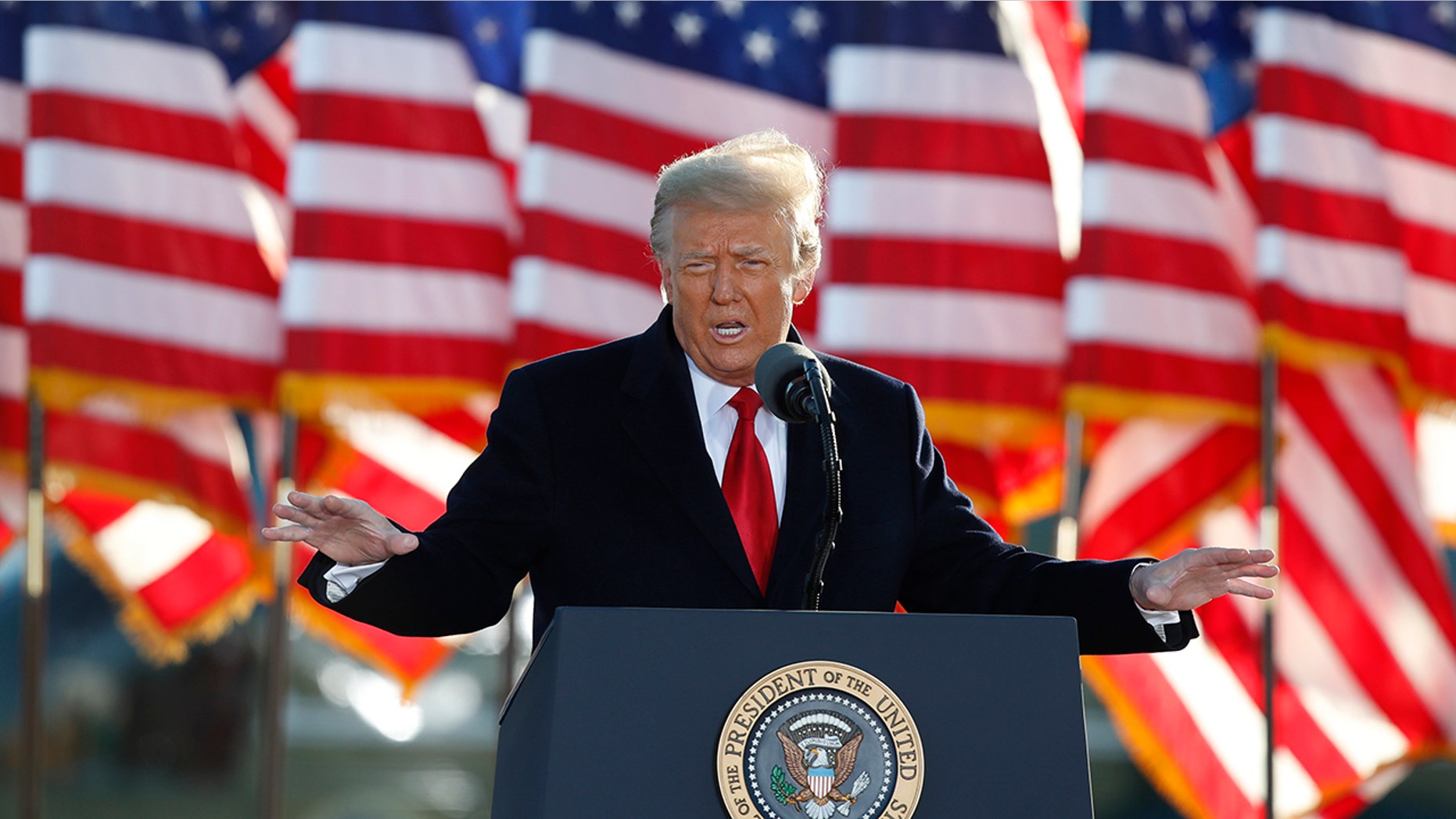
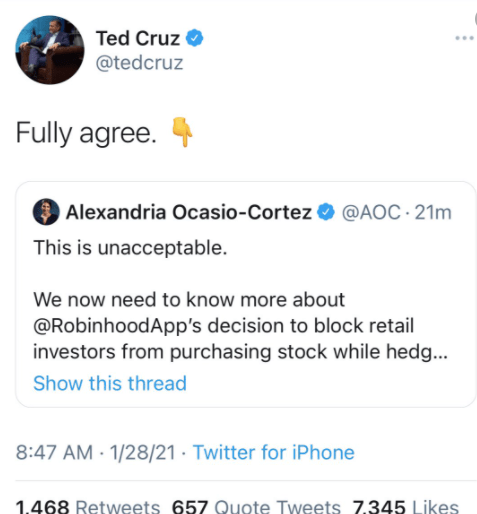
After a tumulus week of Wall street investors losing sleep, the popular stock trading app Robinhood Stocks made a decisive and possibly damning decision. Last Monday the app announced that it would be restricting all purchases of GameStop, AMC, and a few other volatile stocks and limiting users to only using a sell function. In a clear act of market manipulation, and as well as an act against its name-sake principal, this move by Robinhood angered both user and regulators alike. Politicians on both sides of the isle called out the company for its unfair and possibly illegal action. Former President Donald Trump, Texas Senator Ted Cruz, and New York Representative AOC all spoke out against the app’s move.

13 Representative have called for the Robinhood CEO Vlad Tenev to be requested for a congressional hearing regarding the app’s decision.

While the app has since slowly reopened the buying ability of previously restricted stocks for its user, many are fleeing the app and taking their (now larger than ever) investments with them. Similarly, the restricted do not seem to have pushed many small investors to sell off their stock in GameStop, as the stock price was up 65% from yesterdays closing at the time of writing.

With Robinhood both bleeding customers, facing a slew of law suits, and a possible congressional hearing, its hard to say if their decision to bail out big Wall street investors was worth it. Only time will tell if the app can reclaim consumer confidence, and if the collectivism of reddit stock traders will be here to stay.

Wall street “Revolution ”

The “war” between Reddit Users and Wall Street Hedge Funds may have caught your eye last week as several members of the site’s popular subreddit R/wallstreetbets earned portfolios in the million-dollar range on the skyrocketed GameStop stock “GME”. The company, which many are speculating is nearing its end was a favorite for a often used market strategy called “short selling”, the process of taking out a loan on shares, instantly selling the shares, and then returning the shares once they are at a lower value, thus pocketing the difference. This strategy proved costly as the Internet community discovered the strategy and bought and held the stock, driving its price upward and placing short sellers with a difficult decision to either buy up shares or face massive interest fees.

GameStop's wild ride: how Reddit traders sparked a 'short squeeze' |  Financial Times

This saga reached its climax when Tesla founder Elon Musk’s, who voiced his support for the community and from wallstreetbets tweeted “Gamestonk” a popular meme amongst investors and investing communities. By the end of trading on Friday the price of GME rested at 325 a share. This is notable because the price of this stock at the start of January was a measly 17 dollars a share.

The community is currently experiencing a multitude of emotions and many intend to hold until the fabled “Gamma squeeze” a major squeeze of profits from the hedge funds. Many professionals claim the train has come and gone, and that new investors looking for a pay day should be wary. Still, many in the community claim that if they lost everything they would not mind and that their focus is on the large hedge funds losing even more money. It all makes for a highly anticipated Monday in the stock market, with a huge increase in amateur investments and worries about ripple effects in the rest of the market and the economy.

Follow us on CIMA law group for weekly update news.

The Creation of the “Office of the Former President”

Former President Trump on Monday established an official post-presidency office in Palm Beach County, Florida, setting up an outlet for future public appearances and statements. “The Office of the Former President” will manage Trump’s correspondence, public statements, appearance and official activities, according to a press release from the office. Soon after the formulation of the office, a press release had publized the statement “President Trump will always and forever be a champion for the American People”. The title of the office validly could fuel speculation that Trump may not run for president again in 2024, however, theorists believe otherwise. Viewing this behavior to be the beginning of an entire process with the intention of remaining relevant within the political landscape.

Donald Trump Launches 'Office Of The Former President' In Florida – CBS  Miami

In his time since leaving office, Former President Trump is expected to reside in Florida for the remainder of the cycle, and is surrounded by a handful of loyal aides. As former president Trump is readying an impeachment defense team for next month’s Senate trial, this preparation for a sufficient defense may suggest a considerable level of confidence in winning. Which would ultimately still grant him access in running for the 2024 election cycle. Yet, if Trump were to run again under his speculated formation of the “Patriot Party”, a civil war is bound to occur within the GOP. Even if Trump were to create the Patriot Party, it is estimated that as little as 15% of the current Republican party is to align under his leadership. If this hypothetical were to turn into reality, this would subject the GOP to reorganizing in order to remain a competitive force within elections, otherwise, Democrats will have no real opponent to look out for a reasonable amount of time.

The Electoral College: II

    Last time, I wrote a brief piece about the history of the Electoral College. To keep this discussion relevant, I will now focus on the pros and cons of the current system and what this setup means for future Presidential elections. At its birth, the Electoral College was created as another structure of the Representative Democratic system utilized in the United States, whereby citizens vote for people to make decisions on their behalf, instead of voting on policies and the like directly. However, since the 1820s, the Electoral College is more of a proxy for the popular vote in each state. Though not still used as intended, the Electoral College still has its benefits. 

Pros

Because Presidential candidates are (somewhat) resource constrained when on the campaign trail, they must choose the most optimal way to spend their time and money. As the political strategists will attest, the best place for them to spend their resources is in swing states. The winner in the Presidential Election in the majority of states in the U.S. is generally known well before any election, and the amount of time and money an opposition candidate would have to spend in that state to even have the possibility of flipping enough votes to change the color makes it generally not worth the effort. Instead, they will go to states that could swing either way because there is a pretty even split between voters in the two parties. In these states, a candidate only has to convince a small fraction of the voters to vote for them to win, thus these states are the best “bang for your buck”. To pander to the voters in these states, candidates often gear their policies around issues important to citizens in these states, giving states, like Minnesota, power that they may not have had in a popular vote contest. Furthermore, because these states are so closely divided, more moderate candidates can be more likely to win, because their policies can capture more swing voters than a less moderate candidate. This means that a more moderate candidate is more likely to win the election, so even if one person’s chosen candidate does not win, they will be better off than if a less moderate candidate won. 

Cons

In the Electoral College, each vote does not count equally. When Republicans in California and Democrats in Alabama go to cast their votes for President, they are essentially casting their votes straight to the trash can. In both of these states, the contest has been decided years in advance. In fact, no opposition party has won in California and Alabama since the turn of the millennium, and there is no indication that things will be changing soon. Because that is known, voting for the opposition party will have no bearing on the result in a winner-take-all system. On the other hand, a vote from a swing voter in Pennsylvania has enormous value, as these votes can change entire elections. Moreover, giving more power to swing states can lead to candidates adjusting their platform to address issues that are very important to a specific state at the expense of issues that are important nationally. We saw an example of this in the Vice Presidential Debate of 2020, where  Harris and Pence spent a significant amount of time addressing an issue that is mostly important to rural, western Pennsylvania. The most glaring issue, arguably, with the Electoral College is that it may not represent the will of the people. For example, In 2016, Donald Trump won the Electoral College but lost the Popular Vote. This is not the first time that this has happened: in 2000 Bush won the Electoral College but lost the popular vote. Finally, there is the issue of rogue Electors. Since technically each Elector is still a person, there is always the possibility that they will defy their state’s order and vote for their preferred candidate. Though it has never been consequential, it has the potential to turn an election.

America’s Future Presidential Elections

What does this system mean for America’s political future? Well, likely more of the same: arguing about whether or not the Electoral College should be abolished, with little probability that that will happen. To abolish the Electoral College, the Constitution would need to be amended, which takes 2/3rds of the House and Senate agreeing, on top of 3/4ths of the states. This is a difficult hurdle to overcome, though not impossible. 

However, there has been one proposal that has aimed to circumvent this high bar to Electoral College abolition: the National Popular Vote Interstate Compact. This compact states that its member states will award all of their Electors to the winner of the national Popular Vote, effectively creating a true proxy of the Popular Vote. For this measure to be put into play, the compact must gain 270 electoral votes, thus ensuring that the winner of the Popular Vote would win the election. As of 2021, fifteen states and the District of Columbia have signed onto this compact, totaling 196 electoral votes. It is unclear whether or not this Compact will shape the future of elections, as it has not as yet received the necessary support of Republican state governments. 

Design a site like this with WordPress.com
Get started