Last week, the United States formally declared that the atrocities and ethnic violence Myanmar’s military has committed against the country’s Rohingya minority constitute a “genocide,” following a yearslong campaign by advocates of the minority group and global human rights organizations urging the United States to do so, alongside a formal lawsuit against Meta.
International attention on Myanmar’s offensive against the Rohingya intensified when violence against the ethnic group peaked in 2017, following years of repression. The five-year gap between the surge in violence and the U.S. genocide declaration led some human rights activists to criticize Washington for taking too long to make the determination, and they have called on the Biden administration to step up efforts to protect the Rohingya.
The Rohingya are a mostly Muslim ethnic group in Buddhist-majority Myanmar, representing just about 1 million of Myanmar’s total population of 55 million. Most Rohingya live in Myanmar’s Rakhine state, where more than 69 percent of the population lives in poverty. The roots of ethnic and religious conflict in Myanmar go back decades, specifically back to the British colonial era. And in 1962, when the Myanmar military launched a successful coup against the country’s civilian-led government, the dictatorship of military commander Ne Win began.
Under Ne Win’s dictatorship, campaigns were launched against a number of armed groups seeking greater autonomy for the various ethnic and religious minorities in the country’s borderlands. Over time, these efforts and discriminatory laws coalesced around the Rohingya specifically. By 1978, Rohingya were forced to register as “foreigners,” marking the community’s first mass migration to neighboring Bangladesh. Myanmar’s 1982 citizenship law only worsened the Rohingya’s treatment, as it formally denied all Rohingya political rights and citizenship status. In 1991, Myanmar’s “Clean and Beautiful Nation” campaign—meant to expel so-called foreigners from Rakhine state and prevent the expansion of the Rohingya Solidarity Organization, a political insurgency group—led to the mass destruction of Rohingya communities, forcing 250,000 more people to flee to Bangladesh. Over the next three decades, several waves of ethnic and religious violence and brutal military crackdowns on the Rohingya occurred, and in 2017, the government held more than 120,000 Rohingya in internment camps and had killed thousands of people, according to the U.S. Holocaust Memorial Museum. This number is now estimated to be much larger.
On Monday, U.S. Secretary of State Antony Blinken announced that the United States has formally determined that “members of the Burmese military committed genocide and crimes against humanity against Rohingya.” The U.S. designation focuses on mass atrocities committed in 2016 and 2017, when more than 800,000 Rohingya were forced to flee from violence.
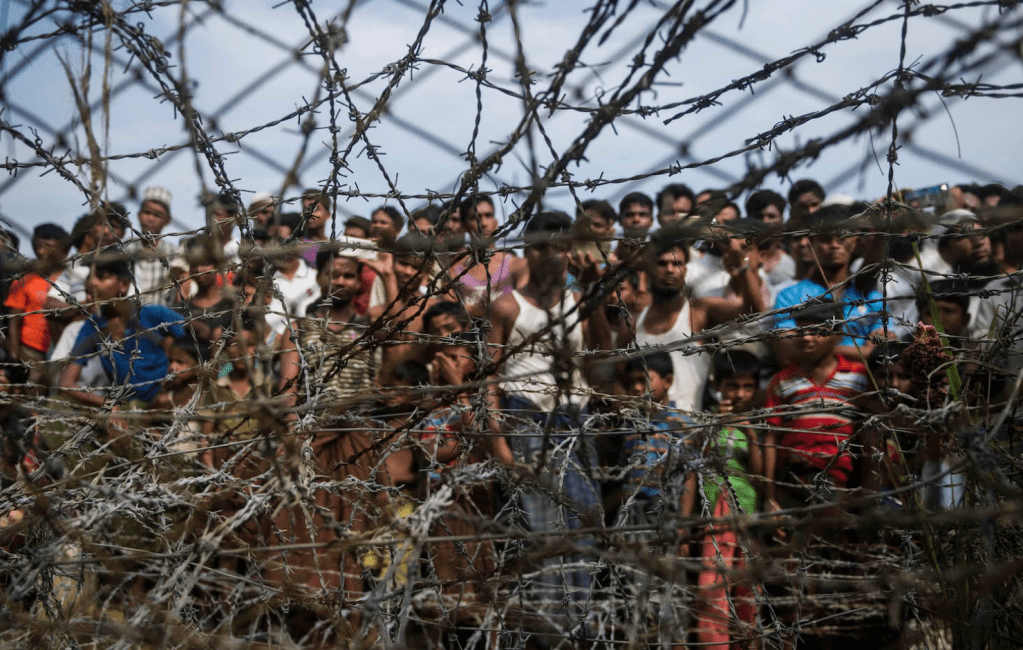
Blinken’s acknowledgement that the Myanmar military’s crimes against the Rohingya amount to a genocide marks the eighth time the United States has determined a genocide was committed since the Holocaust. The U.S. government has declared genocide in past ethnic cleansing campaigns and massacres in Bosnia; Rwanda; Darfur in Sudan; northern Iraq, where the Islamic State targeted Yazidi Christians (once in 2016 and once in 2017); Armenia; and, most recently, western China, where the Chinese government has conducted a crackdown on ethnic Uyghurs and other minorities.
In his formal statement, Blinken announced the United States is applying targeted sanctions against 65 Myanmar leaders and their associates, as well as sanctions and export controls on 26 entities accused of human rights abuses or of funding the Myanmar military. In addition, the United States pledged to give almost $1 million in additional funding for the mechanisms investigating the crimes. This is on top of $1.6 billion provided to Rohingya refugees since 2017. But for many, promises of sanctions are not enough. Activists continue to urge the U.S. to take definitive action in holding the militia juncta accountable.
While past determinations have shed light on genocide and encouraged the international community to take tangible action, this designation (like those before it) certainly doesn’t mean the genocide will end anytime soon. Instead, activists are calling for tangible punishments for perpetrators of genocide and for support for victims’ communities, including the hundreds of thousands of Rohingya now belonging to the diaspora. This includes advocating for U.S. funding for Gambia’s International Court of Justice case against Myanmar, which argues that Myanmar violated the 1948 Genocide Convention, which both countries have ratified.
Acknowledgement from the U.S. seems to be the first step in a series of actions that should be taken to hold Myanmar’s diktat accountable. And while it is an important one to take, the ones following it seem to have a global deterrent effect for other countries to follow suit. Punishment against governments committing human rights violations is necessary to prevent gender-, ethnicity-, and race-based violence.
While U.S. acknowledgement is a definite win, the elephant in the room remains: The U.S. recognizes injustice if convenient, and ignores, or even perpetuates, injustice for its benefit. International crimes committed in Palestine, India, Nagorno-Karabagh, Syria, Yemen, Afghanistan, Iraq, and many more remain unanswered for.
Apparently, something must be done, other than acknowledge injustice, in order to stop injustice. Whether the power to do so lies within the United States, European Union, United Nations, or some other global entity/coalition is unbeknownst to the ordinary person. But activists and journalists who report on continuously ignored global issues are fighting half a battle that ultimately need to be addressed at higher levels of government.
This blog post is part of the CIMA Law Group Blog. If you are in need of legal help, the CIMA Law Group is a law firm in Phoenix, Arizona which possesses expertise in Immigration Law, Criminal Defense, Personal Injury, and Government Relations.




 CIMA Law Group Blog